What AI Actually Does When a Customer Asks for a Recommendation About Your Business
Most organizations have no idea what happens inside an AI system when a customer asks about them. This essay maps the mechanics of AI recommendation generation — and what organizations must do to influence the outcome.
A prospective customer opens ChatGPT, Perplexity, or Claude and types: "What's the best provider of X in my industry?" or "Has anyone had good results with Company Y?" What happens next determines whether your organization is recommended, ignored, or misrepresented — and almost no business leadership team has a clear picture of that process.
Key Takeaways
- AI recommendation generation is a multi-step process involving query interpretation, source retrieval, synthesis, and confidence weighting — each step is an opportunity for your organization to appear or disappear
- The question a customer asks is not the question AI systems answer — AI systems interpret and reframe queries, and organizations must be represented in the categories those reframings produce
- AI systems do not have opinions — they synthesize patterns from source material, which means the quality of your source material determines the quality of your AI representation
- Confidence thresholds determine inclusion: AI systems omit organizations they have insufficient information to represent accurately, even if those organizations are genuinely relevant
- Recommendation context matters more than general visibility — being mentioned somewhere in AI systems is not the same as being mentioned when someone asks for a recommendation in your specific use case
- The difference between being recommended and being mentioned is the difference between a warm lead and background noise
- Negative signals in source material are synthesized alongside positive ones — AI recommendations reflect the full texture of available information, not just your marketing narrative
- Organizations can audit and influence their recommendation profile by understanding which queries generate which responses, and which sources drive those responses
Quick Answer
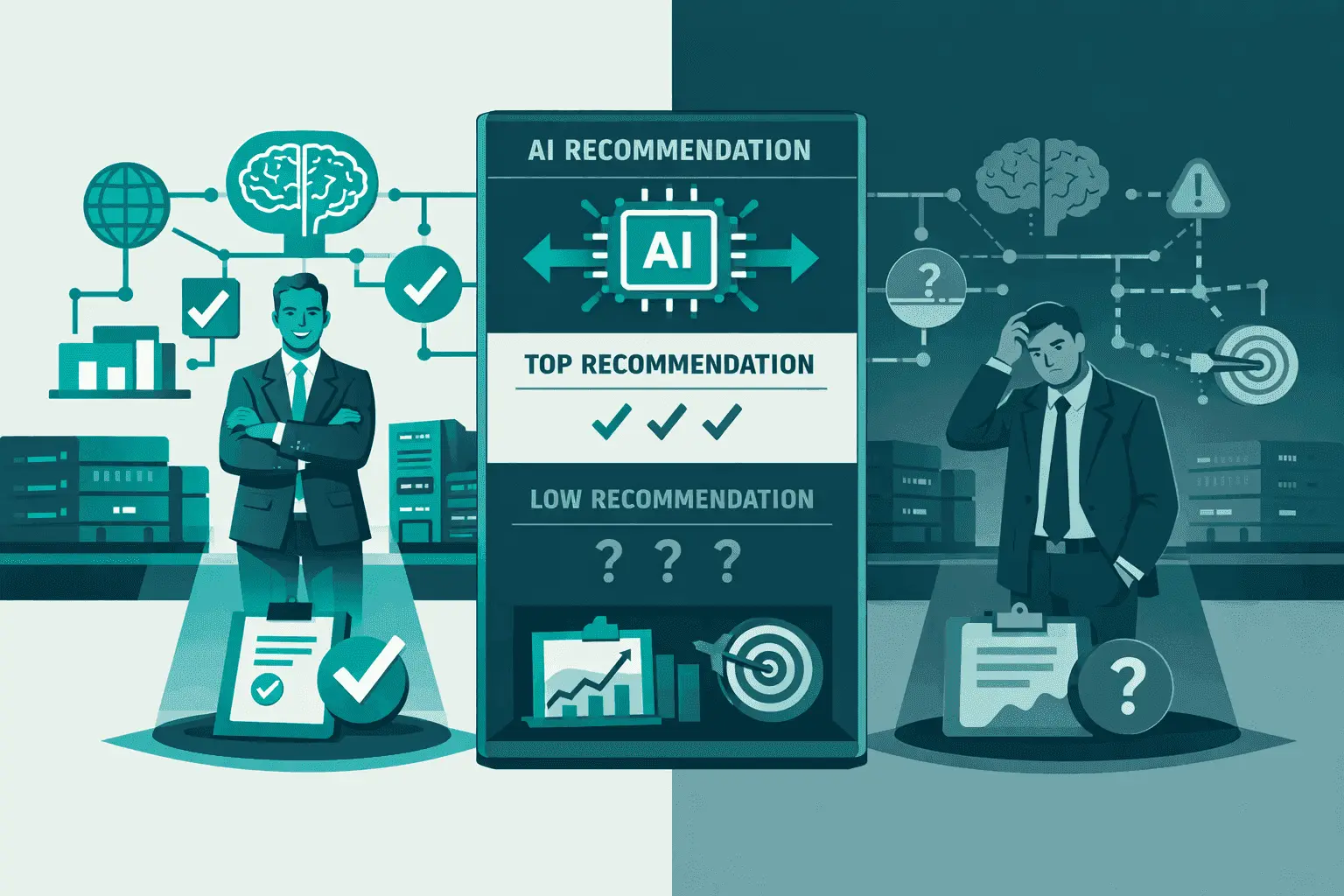
When a customer asks an AI system for a recommendation involving your business, the system executes a sequence: it interprets the query intent, retrieves relevant source material from its training data or live web index, evaluates the authority and relevance of those sources, synthesizes a response that reflects the weighted patterns across those sources, and applies confidence calibration before generating output. Your organization appears in the final recommendation only if it clears multiple thresholds at each stage of this process. Understanding those thresholds is the starting point for influencing the outcome.
Stage 1: Query Interpretation
The question a customer types is rarely the question an AI system answers. AI systems perform query interpretation — they analyze the intent behind a query and reframe it into the form they can answer most accurately.
When a customer asks "what's a good CRM for a 50-person professional services firm," the AI system does not simply search for "CRM." It interprets several embedded parameters: company size (50 people), industry (professional services), and product category (CRM). The system then generates a response calibrated to that specific combination — not a general CRM recommendation.
The implication for your organization: you must be represented in the specific intersection of categories that your target customers' queries will invoke. Being associated with "CRM" generally is not enough if your positioning is specifically in professional services. Being associated with professional services CRM in AI source material is what causes your organization to appear when that specific query is interpreted.
Organizations that use broad, generic positioning — "we serve businesses of all sizes across industries" — are less likely to appear in queries that include specific parameters than organizations with clear, specific positioning that maps to real customer query patterns.
Stage 2: Source Retrieval
After interpreting the query, AI systems retrieve the source material they will use to generate a response. This retrieval operates differently depending on the AI system type.
Training-data-based systems (like the base versions of GPT-4 or Claude) draw from knowledge embedded during training. This knowledge was compiled from web content up to a training cutoff date. Retrieval in these systems is not a live web search — it is pattern matching against compressed representations of the training corpus. Organizations that were not well-represented in training data face structural disadvantage in these systems.
Retrieval-augmented systems (like Perplexity, ChatGPT with browsing enabled, or Claude with web access) perform live web retrieval at query time. They fetch current web content and synthesize it into a response. Organizations with current, accessible, authoritative web content have more influence over retrieval-augmented systems than over pure training-data systems.
Hybrid systems combine both — using training-data knowledge supplemented by live retrieval for recency and specificity.
The practical implication: different AI systems require different strategies. Training-data systems require long-term source authority building. Retrieval-augmented systems reward current, accessible content that addresses specific query contexts. Organizations targeting AI visibility need to understand which systems their customers use and calibrate accordingly.
Stage 3: Source Authority Evaluation
Not all retrieved sources are weighted equally. AI systems apply implicit authority evaluation to determine how much each source should influence the synthesized response.
The authority signals AI systems recognize include: domain authority of the source, independence from the subject being described, specificity of claims, recency, cross-referencing by other authoritative sources, and consistency across multiple independent sources making similar claims.
This is where most organizations have their largest gap. The content they have published — on their own website, in their own press releases — carries lower authority weight than independent sources. An organization's own description of itself is the least authoritative source an AI system can use.
What passes the authority threshold: analyst reports naming the organization in a market analysis, editorial coverage in industry publications, peer community discussions where practitioners recommend the organization by name, academic citations, structured database entries, and third-party review platform profiles with substantial review volume.
What fails the authority threshold: the organization's own website copy, press releases on wire services, sponsored content, and AI-generated content that simply rephrases the organization's marketing materials.
Stage 4: Synthesis and Pattern Weighting
Once source material is retrieved and authority-evaluated, AI systems synthesize a response by identifying patterns across sources. The synthesis process does not simply quote sources — it identifies what the accumulated evidence most strongly supports and generates original language expressing that synthesis.
Consensus patterns dominate synthesis. If fifteen independent sources describe an organization as strong in enterprise implementations and two describe it as relevant for SMBs, the synthesis will reflect the enterprise positioning. Organizations cannot correct synthesis patterns by publishing one strong counter-narrative — they must shift the underlying source pattern.
Specific claims survive synthesis better than general ones. A synthesis algorithm selecting for quotable, specific statements will preferentially extract "reduces implementation time by 40%" over "fast implementation." Organizations that make specific, quantified claims in their source material see those claims appear in AI syntheses. Organizations that use only general marketing language see that language stripped out in synthesis.
Recency modulates synthesis. AI systems that have access to recent content will blend historical pattern evidence with recent signals. An organization that has recently repositioned — and has published credible, authoritative content reflecting that repositioning — can influence synthesis more than one relying solely on old content.
Stage 5: Confidence Calibration and Inclusion Threshold
Before generating a recommendation, AI systems apply confidence calibration: they assess how well-supported each potential recommendation is and suppress recommendations where evidence is thin or contradictory.
This is the stage where organizations with thin source presence are eliminated. An AI system asked to recommend providers in a specific category will include organizations for which it has sufficient, consistent, authoritative evidence. Organizations for which it has minimal or contradictory evidence may be omitted entirely — even if those organizations would genuinely be good recommendations.
The confidence threshold creates a structural barrier that cannot be cleared by a single press release or blog post. It requires accumulated evidence across multiple authoritative sources. This is why AI visibility building is a compounding, long-term investment rather than a campaign.
Contradictory evidence suppresses confidence. If your organization is described as "enterprise-focused" by your own content but "SMB-oriented" by analyst reports and community discussions, the contradiction reduces AI confidence in any specific positioning claim. The synthesis may omit you from both enterprise and SMB recommendation sets as a result. Narrative consistency across all sources is directly tied to recommendation inclusion.
What the Full Process Means for Your Strategy
Understanding the five-stage recommendation process reveals why many AI visibility efforts produce limited results. Common mistakes include:
Publishing more website content without addressing source authority. The synthesis stage weights independent sources far above organizational content. More website content does not change the authority balance.
Optimizing for general mentions rather than recommendation-context presence. Being mentioned in AI responses to general brand queries does not translate to being recommended in specific buying-context queries.
Assuming training-data visibility translates to retrieval-augmented visibility. An organization well-represented in training data may perform poorly in live retrieval systems if its current web content is thin or technically inaccessible.
Ignoring negative source signals. AI synthesis reflects all source signals, including negative ones. Critical reviews, public complaints, and negative press coverage are synthesized alongside positive signals. Suppressing negative signals requires the same source management approach as building positive ones.
The effective strategy addresses all five stages: ensure your positioning maps to real query interpretation patterns, build authoritative source presence that passes retrieval thresholds, achieve citation in authority-weighted sources, make specific and quotable claims that survive synthesis, and generate sufficient consistent evidence to clear confidence thresholds for recommendation inclusion.
FAQ
Why does my organization appear in some AI responses but not recommendation queries?
Brand mention queries and recommendation queries trigger different retrieval and synthesis patterns. Recommendation queries require higher confidence thresholds and specific positioning alignment. An organization may be mentioned in general queries while failing confidence thresholds for specific recommendation contexts.
How do we know which queries our target customers are actually using?
Query pattern research involves testing AI systems with the questions your sales team hears most often, the questions your website search logs reveal, and the questions that appear in community forum discussions in your market. Mapping these query patterns to AI response patterns reveals gaps.
Can a competitor's negative content about us affect AI recommendations?
Potentially, if that content appears in authoritative sources. AI systems synthesize patterns across sources and do not filter for commercial relationships between sources. Content published by competitors in independent-looking contexts can influence synthesis if it carries authority weight.
How long does it take for source improvements to affect AI recommendations?
Variable by system type. Retrieval-augmented systems may reflect new authoritative content within days or weeks of indexing. Training-data-based systems update on training cycles that may be months apart. A comprehensive strategy addresses both.
What is the most direct lever for improving recommendation inclusion?
Building authoritative third-party source presence — analyst coverage, editorial mentions in high-authority publications, and peer community discussion — has the most direct impact on confidence threshold clearance. It is also the longest-lead-time investment, which is why starting early is significant.
Does having many reviews on G2 or similar platforms help?
Yes. Review platforms are indexed and treated as peer opinion sources. Substantial review volume on relevant platforms contributes to the pattern evidence AI systems use for recommendation synthesis, particularly for software and service categories.
Should we try to influence how AI systems answer questions about us directly?
You cannot directly program AI system outputs. The influence mechanism is always upstream: change the sources, change the patterns, change the synthesis. Organizations that attempt to game AI systems directly through keyword stuffing or AI-targeted content manipulation typically produce low-authority content that does not pass synthesis thresholds.
References
[1] Ai Mediated Buying Journeys How Buyers Decide Whos Worth Their Time - https://www.idc.com/resource-center/blog/ai-mediated-buying-journeys-how-buyers-decide-whos-worth-their-time/
[2] How Ai Is Transforming Search And Discovery - https://www.forbes.com/sites/forbestechcouncil/2026/01/15/how-ai-is-transforming-search-and-discovery/
[3] The Shift From Search Engines To Answer Engines - https://www.searchenginewatch.com/2026/01/shift-from-search-to-answer-engines/
[4] Generative Engine Optimization Geo Strategies - https://www.siegemedia.com/strategy/generative-engine-optimization
[5] How Ai Synthesizes Information From Multiple Sources - https://www.contentatscale.ai/blog/ai-content-synthesis/
[6] State Of Ai Search Optimization 2026 - https://www.growth-memo.com/p/state-of-ai-search-optimization-2026
[7] Zero Click Searches The Future Of Seo - https://moz.com/blog/zero-click-searches-future-of-seo
[8] Ai Visibility Tools Comparison 2026 - https://www.searchparty.com/blog/ai-visibility-tools-comparison-2026
[9] Brand Visibility In The Age Of Ai - https://mcfadyen.com/articles/brand-visibility-in-the-age-of-ai/
[10] Measuring Success In The Age Of Ai Search - https://www.conductor.com/blog/measuring-ai-search-success/
About the Author
Sergio D'Alberto is the founder of ABL (AI.BUSINESS.LIFE.), an AI strategy and adoption advisory. His work focuses on helping leadership teams navigate AI governance, visibility strategy, and responsible adoption.
Prior to founding ABL, Sergio spent 16 years at Microsoft, most recently in Azure Engineering.
Related Essays
The Invisible Website: Why AI Crawlers Cannot Read Most Modern Business Websites
Most modern business websites are technically invisible to AI crawlers. This essay explains the structural reasons why, and what organizations must do to become readable to the systems that now mediate business decisions.
AI Does Not Rank. It Rewrites.
Understanding the fundamental shift from ranked search results to AI-synthesized answers and what this means for organizational visibility and competitive positioning.
When AI Chooses for Your Customer: The Rise of AI-Mediated Decisions
How AI systems increasingly mediate business decisions before human engagement, creating new governance imperatives for organizational visibility and competitive positioning.