The Entity Gate: Why AI Either Knows You Exist or Skips You Entirely
AI systems organize their knowledge around entities — recognized, named things with defined attributes. If your organization is not established as a recognized entity, AI systems cannot reference you reliably. This essay explains the entity recognition threshold and how to cross it.
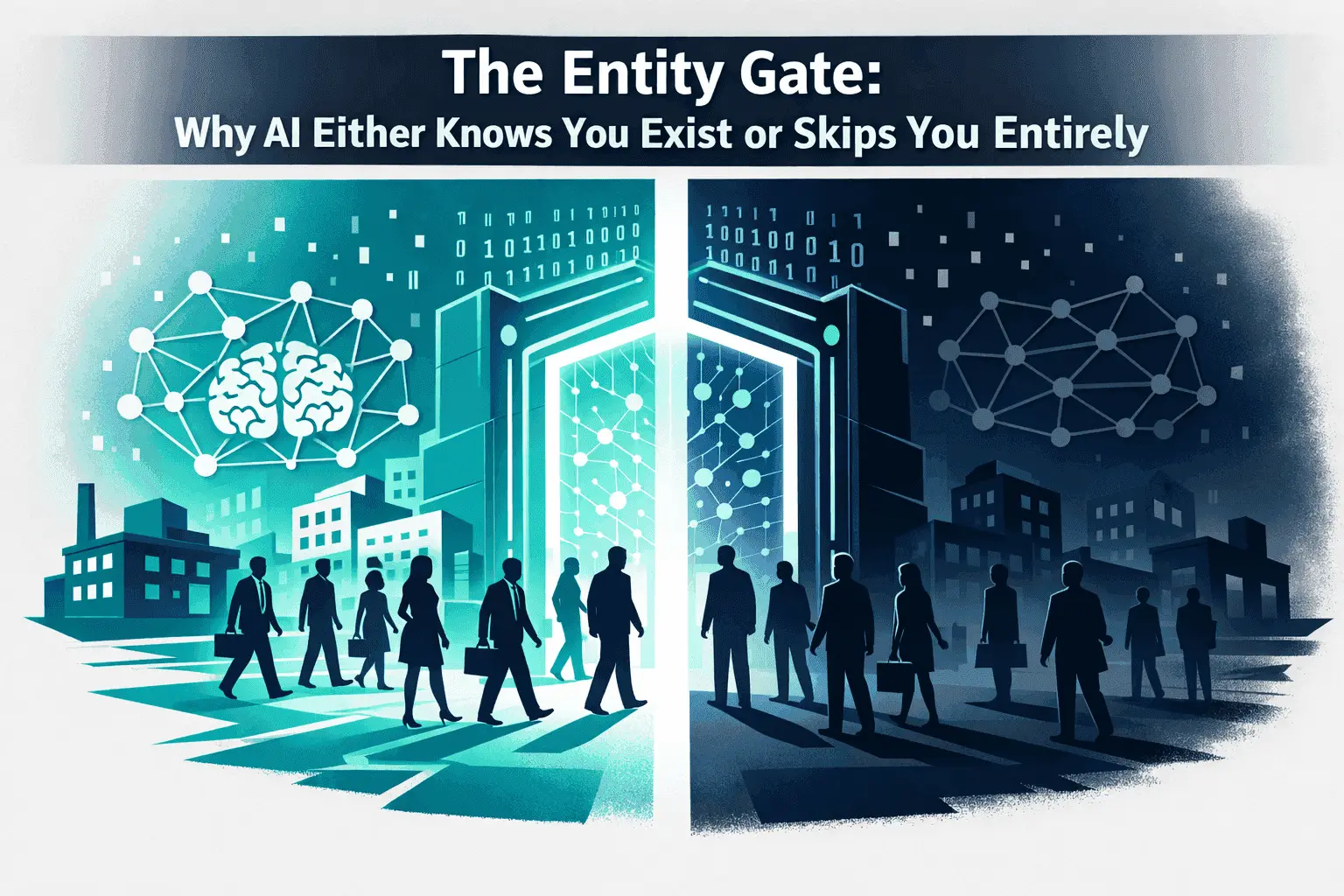
There is a threshold in AI systems below which an organization does not exist in any meaningful sense. Not misrepresented. Not mentioned occasionally. Simply absent — treated as a concept that the AI system cannot reliably reference, describe, or recommend. This threshold is the entity gate, and crossing it is the most fundamental requirement of AI visibility.
Key Takeaways
- AI systems organize knowledge around entities: recognized, named things with defined attributes, relationships, and categorical memberships
- Entity recognition is binary at its base: an organization either has enough consistent, cross-source evidence to be treated as a recognized entity, or it does not
- Below the entity threshold, AI systems avoid mentioning organizations even when those organizations are genuinely relevant, because they cannot generate confident, accurate descriptions
- The entity gate applies across all AI systems — it is not platform-specific but reflects a fundamental property of how language models represent knowledge
- Crossing the entity gate requires consistent, cross-source information about who the organization is, what it does, and how it relates to recognized categories and other entities
- Wikipedia and Wikidata are disproportionately important for entity recognition — their structured, cross-referenced format is exactly what AI entity systems process most effectively
- Knowledge Graph inclusion — in Google's Knowledge Graph and equivalent structured databases — directly correlates with AI entity recognition
- Once an entity is established, AI visibility work shifts to representation quality; before it is established, almost nothing else works
Quick Answer
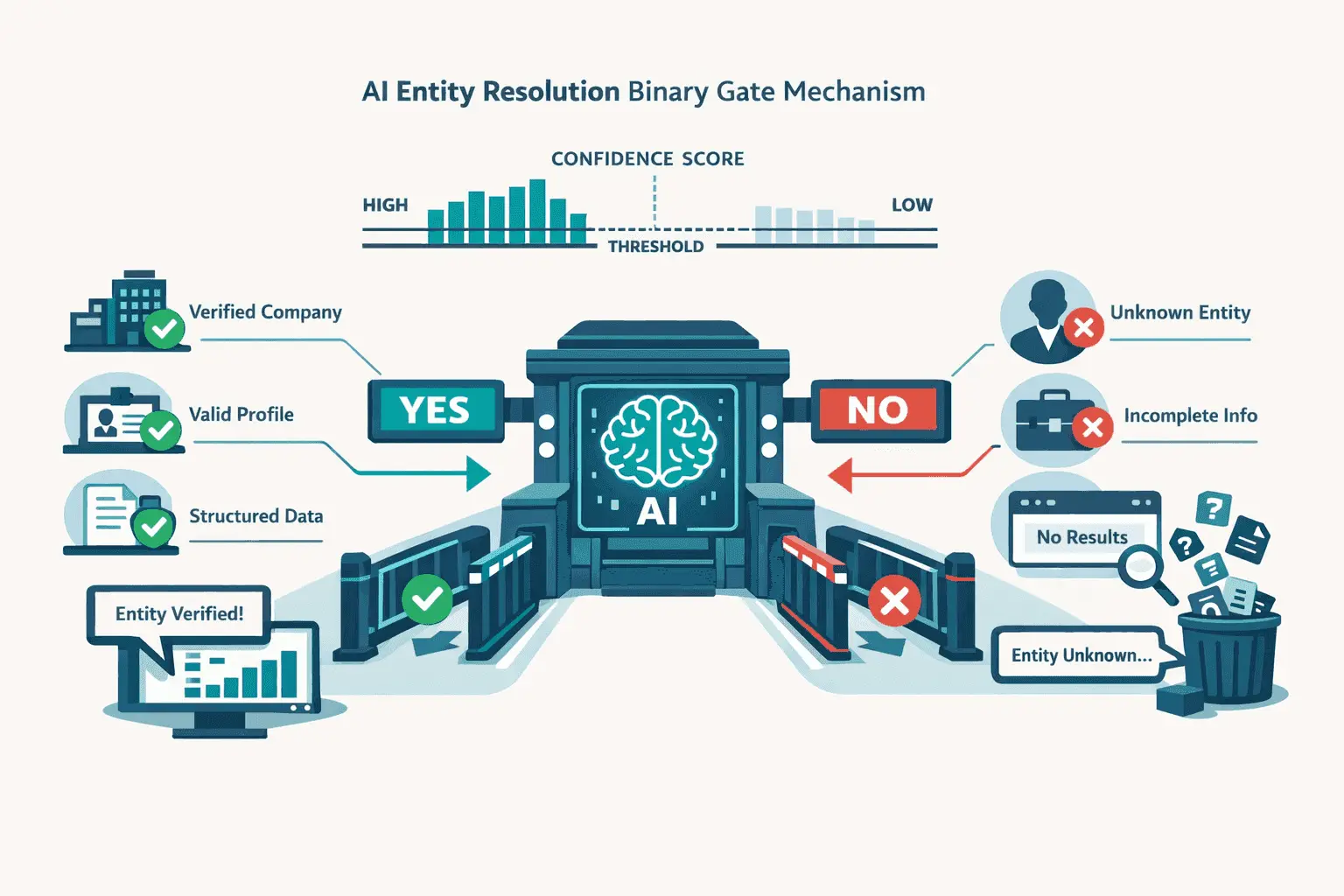
AI language models do not simply store text — they build compressed representations of entities: people, organizations, places, concepts, and products that appear consistently across their training data. When enough consistent evidence exists across enough independent sources, the model forms a stable entity representation. When evidence is thin, inconsistent, or siloed on the organization's own website, no stable entity representation forms. The result is not poor AI visibility — it is the complete absence of a confident organizational identity that AI systems can reference. Crossing the entity gate is the prerequisite for everything else in AI visibility strategy.
How AI Systems Represent Entities
To understand the entity gate, it helps to understand what happens inside an AI system when it encounters a name repeatedly during training.
During training, language models process vast quantities of text. When a name — an organization, a person, a product — appears repeatedly across diverse, independent sources, the model begins to form a stable representation of that entity. It learns: what category this entity belongs to (company, not person, not place), what attributes describe it (industry, size, location, specialization), what other entities it relates to (competitors, partners, clients, founders), and what claims are consistently associated with it.
This representation is what allows AI systems to generate confident, specific descriptions of an entity when asked about it. When a user asks "what does Company X do," the AI system retrieves its entity representation and generates a description from that compressed knowledge.
When training data about a named organization is insufficient — too sparse, too inconsistent, or too confined to sources the model has not weighted highly — no stable entity representation forms. The model has encountered the name but cannot reliably describe what it refers to. In this state, AI systems do one of three things: they skip the organization in responses where it would be relevant, they generate a hedged and generic description that acknowledges uncertainty, or — in the most problematic cases — they hallucinate plausible-sounding but inaccurate attributes.
The entity gate is the threshold between these two states: confident entity representation and absent or unreliable representation.
The Signals That Form an Entity
Entity recognition in AI systems is not a deliberate process where humans declare that something is an entity. It emerges from patterns in training data. Specific signals, when present across multiple independent sources, accelerate entity formation.
Named and described consistently: the organization name appears consistently spelled and formatted across sources, and the same core description is associated with it. Inconsistency in name spelling (abbreviations, spacing, punctuation) or in core descriptions (described as a consultancy in one source, a software company in another) creates noise that slows entity formation.
Categorically associated: the organization is consistently associated with recognized industry categories, product categories, or service types that AI systems have already formed strong entity representations of. "A cloud security company serving enterprise clients in the DACH region" associates the new entity with established categories (cloud security, enterprise, DACH) in ways that help the AI system position the new entity within its existing knowledge structure.
Relationally embedded: the organization is mentioned in relation to other well-established entities — recognized competitors, known clients, established industry bodies, named founders with their own entity representations. Relational embedding provides context that helps AI systems understand what kind of entity this is by reference to entities they already know.
Present across independent source types: mentions in a company's own website do not contribute significantly to entity formation. Mentions in third-party editorial content, structured databases, community discussions, and public records do. The breadth of independent source types carrying consistent information about the organization is a primary driver of entity formation speed.
Wikipedia and Wikidata: these two sources are disproportionately important for entity recognition. Wikipedia articles are extensively cross-referenced, available in multiple languages, structured in consistent formats, and treated by AI systems as high-authority factual sources. Wikidata provides structured, machine-readable entity information that AI systems can process more directly than prose. An organization with a Wikipedia article and accurate Wikidata entries has crossed a significant threshold in entity formation.
The Entity Gate in Practice
The practical manifestation of the entity gate is observable by directly testing AI systems with queries about an organization.
Signs that an organization has not crossed the entity gate: AI systems say they don't have reliable information about the organization; responses default to generic descriptions of the company type rather than specific descriptions of the organization; the AI hedges with phrases like "I'm not certain, but" or "based on limited information"; the AI produces different descriptions in different sessions, reflecting unstable entity representation; the organization is absent from AI-generated lists of relevant vendors or providers in its space.
Signs that an entity has crossed the gate: AI systems generate consistent, specific descriptions across multiple queries and sessions; the organization appears in relevant category lists and competitive comparisons; the AI can state specific facts about the organization — founding year, headquarters, number of employees, key products or services — with apparent confidence; the description aligns broadly with accurate organizational information even if imperfect in details.
Most organizations find themselves in a spectrum between these states. Larger, older, more extensively covered organizations are well past the entity gate. Smaller, newer, or less-covered organizations — including many legitimate experts in emerging fields — often find themselves below it or right at the threshold.
Why This Is More Important Than Any Content Tactic
Organizations that discover they are below the entity gate often respond with content tactics: more blog posts, more website pages, more SEO-optimized content. This response mistakes the symptom for the cause.
The entity gate is not cleared by self-published content. An organization can publish thousands of pages on its own website and still fail to form a stable AI entity representation, because the sources AI systems use for entity formation are predominantly third-party and independent. More content on a website that AI systems cannot weight as authoritative does not move the needle on entity formation.
The entity gate is cleared by structured, independent, cross-source evidence. The investment that clears the entity gate is:
Pursuing a Wikipedia article if the organization meets notability criteria, or contributing to existing Wikipedia coverage of the space in ways that naturally reference the organization.
Ensuring complete and accurate Wikidata entries for the organization, including industry classification, headquarters location, founding date, founder attribution, and category associations.
Completing and verifying structured profiles on Crunchbase, LinkedIn, industry association databases, and government business registries.
Building editorial coverage in authoritative third-party publications — not press release republication, but independent editorial content that specifically names and describes the organization.
Achieving citation in analyst reports from recognized industry research firms.
Establishing presence in community discussions where practitioners in the relevant field reference the organization by name.
Each of these contributes structured, independent evidence that helps AI systems form stable entity representations. None of them is primarily a marketing investment — which is exactly why the entity gate problem is misdiagnosed when it is handed to marketing teams.
Entity Attributes and Representation Quality
Once an organization has crossed the entity gate, the focus shifts from entity formation to entity attribute quality. The entity representation AI systems have formed contains specific attributes — the claims and characteristics they associate with the organization. These attributes determine how the organization is described, categorized, and recommended.
Core attributes that AI systems typically form for organizations: industry category, geographic focus, company size range, founding period, key products or services, typical client profile, competitive positioning, and notable achievements or recognitions.
The quality of these attributes depends on the quality of the source material that informed them. Vague source material produces vague attributes. Specific, quantified, authoritative source material produces specific attributes that support confident AI representation.
An organization that has crossed the entity gate but has poorly specified attributes will still be mentioned in AI responses — but described generically in ways that do not convey strategic differentiation. Attribute quality work is the next layer after entity formation.
FAQ
How do we know if we've crossed the entity gate?
Test major AI systems (ChatGPT, Claude, Perplexity, Gemini) with direct questions about your organization: "What does [company name] do?", "Where is [company name] based?", "What industry does [company name] operate in?" Consistent, specific, accurate responses across multiple sessions indicate entity formation. Hedged, generic, or inconsistent responses indicate you are at or below the threshold.
Is Wikipedia mandatory for entity recognition?
Not strictly mandatory, but disproportionately influential. AI systems treat Wikipedia as a primary entity reference source. Organizations that meet Wikipedia notability criteria and have an accurate Wikipedia article are significantly more likely to have strong entity representations in AI systems.
How long does it take to cross the entity gate?
Varies significantly based on how much independent coverage already exists and how quickly new authoritative sources can be established. For organizations that actively build the right source types, months is a reasonable timeline. For organizations relying on organic coverage development, years is realistic.
Can a small or newly founded company cross the entity gate?
Yes, if they build the right source evidence quickly. A startup that achieves notable analyst coverage, is included in structured databases, and generates independent editorial coverage in authoritative publications can cross the entity gate faster than a larger organization that has operated quietly without external coverage.
Does a Google Knowledge Panel indicate entity recognition in AI systems?
A Google Knowledge Panel indicates Google Knowledge Graph inclusion, which is a strong signal of entity recognition. Google Knowledge Graph and AI entity representations are distinct but correlated — they draw from many of the same sources (Wikipedia, Wikidata, structured web data). Knowledge Panel presence is a useful positive indicator.
What happens if AI systems have formed an inaccurate entity representation?
Inaccurate entity attributes are a representation risk problem — distinct from the entity gate problem, but related. Correcting inaccurate attributes requires the same upstream source correction approach: publishing accurate information in authoritative third-party sources that will shift the pattern AI systems learned from.
Is entity recognition platform-specific?
Each AI system has its own training data and entity formation process, so the specific state of entity recognition varies by platform. However, the underlying signals that drive entity formation are consistent — organizations that build strong entity evidence across the right source types tend to be recognized across multiple AI systems.
References
[1] Ai Visibility And Brand Representation - https://mcfadyen.com/articles/brand-visibility-in-the-age-of-ai/
[2] How Ai Synthesizes Information From Multiple Sources - https://www.contentatscale.ai/blog/ai-content-synthesis/
[3] State Of Ai Search Optimization 2026 - https://www.growth-memo.com/p/state-of-ai-search-optimization-2026
[4] Ai Tech Trends Predictions 2026 - https://www.ibm.com/think/news/ai-tech-trends-predictions-2026
[5] Ai Search Analytics A Roadmap To Ai Visibility In 2026 - https://www.wpfastestcache.com/blog/ai-search-analytics-a-roadmap-to-ai-visibility-in-2026/
[6] Generative Engine Optimization Geo Strategies - https://www.siegemedia.com/strategy/generative-engine-optimization
[7] The Rise Of Ai Search And What It Means For Seo - https://www.searchenginejournal.com/the-rise-of-ai-search-and-what-it-means-for-seo/
[8] Wikidata Entity Representation And Knowledge Graphs - https://www.wikidata.org/wiki/Wikidata:Introduction
[9] Measuring Success In The Age Of Ai Search - https://www.conductor.com/blog/measuring-ai-search-success/
[10] Ai Visibility Tools Comparison 2026 - https://www.searchparty.com/blog/ai-visibility-tools-comparison-2026
About the Author
Sergio D'Alberto is the founder of ABL (AI.BUSINESS.LIFE.), an AI strategy and adoption advisory. His work focuses on helping leadership teams navigate AI governance, visibility strategy, and responsible adoption.
Prior to founding ABL, Sergio spent 16 years at Microsoft, most recently in Azure Engineering.
Related Essays
Google Rank Is Not AI Visibility: Understanding the Fundamental Difference
Ranking well on Google does not mean AI systems know who you are. This essay maps the structural differences between search ranking and AI visibility — and why organizations that conflate them are making a costly strategic error.
Why Press Releases Are Invisible to AI and What Actually Builds Citation Authority
Press releases have almost no impact on AI visibility. This essay explains why the standard PR approach fails in AI-mediated contexts — and what organizations should do instead to build the citation authority that AI systems actually recognize.
Why Reddit Has Become One of the Most Important AI Visibility Assets for Your Business
Reddit is not a social media channel. For AI systems, it is a high-authority source of peer opinion, product context, and industry narrative. This essay explains why Reddit presence now shapes AI-generated business representations.