Why Press Releases Are Invisible to AI and What Actually Builds Citation Authority
Press releases have almost no impact on AI visibility. This essay explains why the standard PR approach fails in AI-mediated contexts — and what organizations should do instead to build the citation authority that AI systems actually recognize.
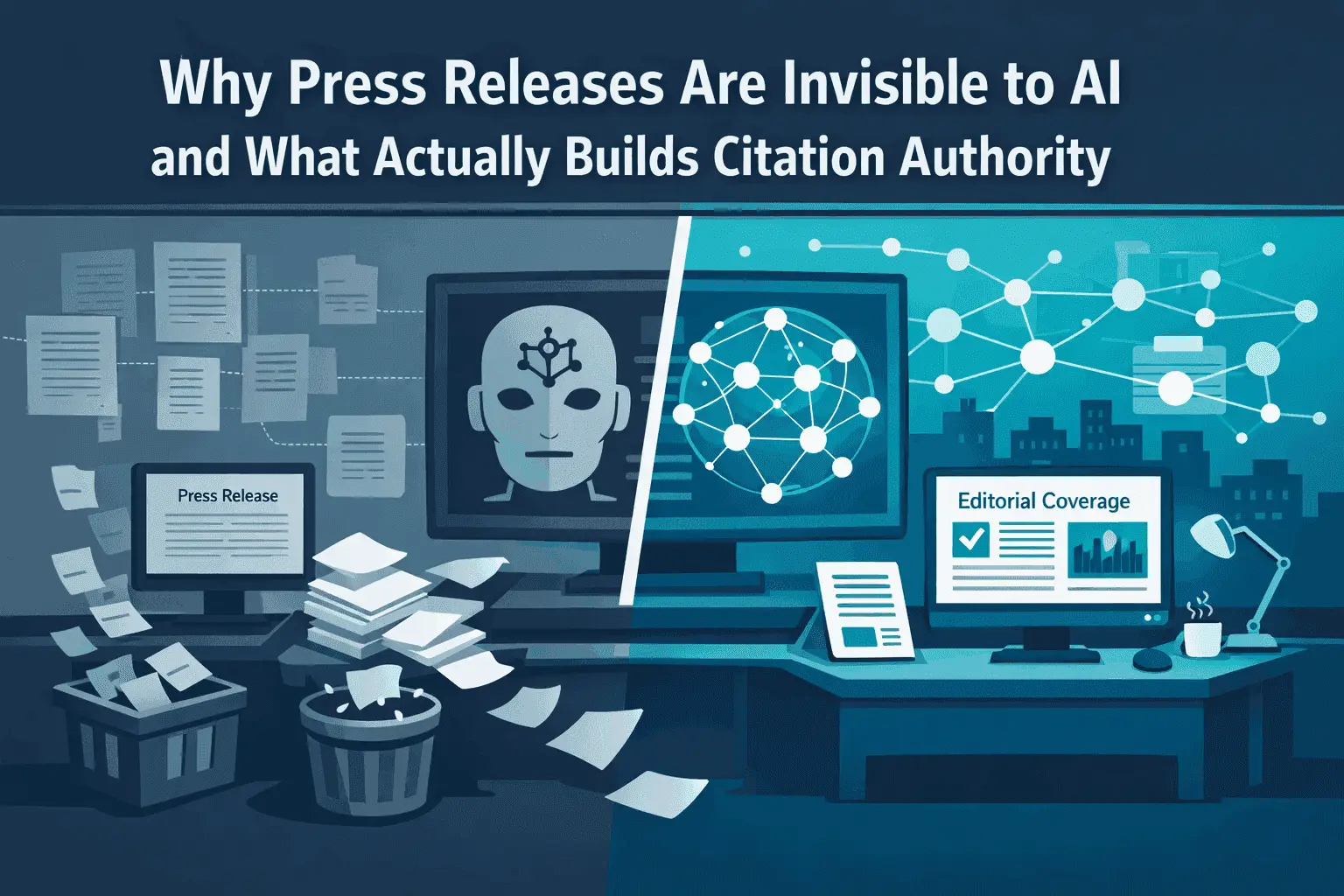
Every week, organizations publish press releases announcing product launches, executive appointments, partnerships, and milestones. Communications teams distribute them through wire services, post them to newsroom pages, and track media pickups. Almost none of this activity has meaningful impact on how AI systems represent those organizations.
Key Takeaways
- Press releases distributed via wire services are among the lowest-weight content types for AI citation and representation
- AI systems do not treat self-published organizational announcements as authoritative sources — they treat them as promotional content
- The PR metrics that matter for human media — pickups, impressions, reach — do not translate to AI visibility metrics
- Citation authority comes from being referenced by sources that AI systems already trust, not from publishing content that claims authority
- Third-party editorial coverage, analyst reports, and peer community mentions carry far more AI weight than any volume of press releases
- The format of press releases — written for journalists, dense with promotional language, rarely containing quotable expert claims — makes them structurally poor source material for AI synthesis
- Earned media still matters, but the mechanism has changed: what matters is not the number of mentions but the authority profile of the sources doing the mentioning
- Organizations that understand AI citation authority invest in fundamentally different activities than those optimizing for traditional PR metrics
Quick Answer
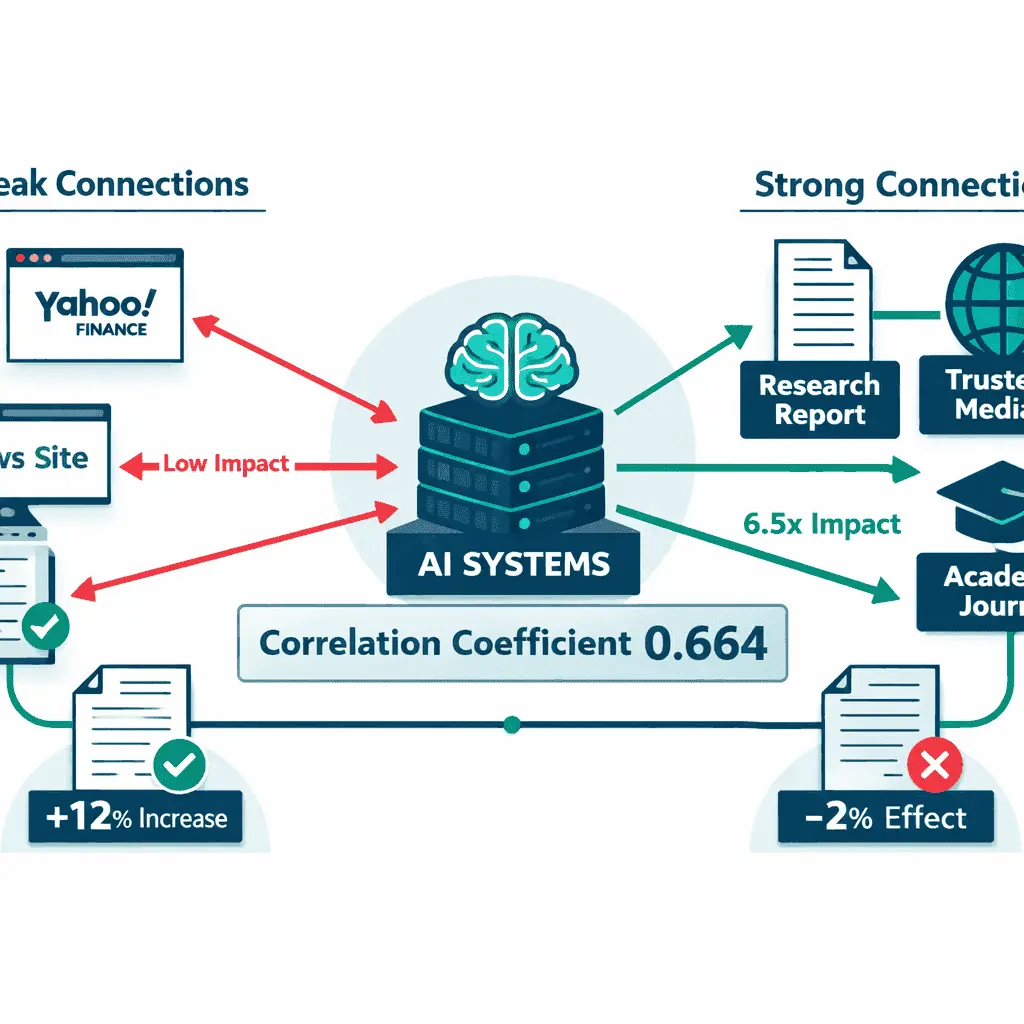
AI systems evaluate the credibility of sources before synthesizing them into responses. Press releases are organizational announcements, and AI systems correctly identify them as such — they carry the same epistemic weight as marketing copy, not independent verification. What builds AI citation authority is being referenced by sources that AI systems have already classified as authoritative: established publications, independent analysts, academic institutions, professional communities, and structured databases. Citation authority cannot be self-asserted. It must be earned from sources that do not have a promotional relationship with the organization.
Why AI Systems Discount Press Releases
The logic AI systems apply to source evaluation is not arbitrary. It mirrors the logic that humans apply when assessing credibility: information is more trustworthy when it comes from sources that do not have an interest in presenting a particular view.
A press release is, by definition, produced by the organization it describes. AI systems that have been trained to recognize the difference between editorial and promotional content identify press releases as promotional — regardless of where they are distributed.
Wire service distribution does not add authority. PR Newswire, Business Wire, Globe Newswire, and similar services distribute press releases to a large audience, but the content remains unchanged. An organization's own announcement distributed broadly is still the organization's own announcement. AI systems do not weight wire service distribution as independent editorial endorsement.
Newsroom pages on company websites face the same problem. Press releases published in a company's "News" or "Press" section are clearly organizational content. They may be indexed and readable by AI systems, but their authority weight is equivalent to other organizational content — low relative to third-party sources.
The format compounds the problem. Press releases are written to inform journalists, not to be directly quoted by AI systems. They typically contain promotional language ("leading provider," "best-in-class solution," "revolutionary platform") that AI systems have been trained to identify as marketing language rather than factual claims. They rarely contain the specific, quotable, evidence-backed statements that AI systems extract when synthesizing authoritative descriptions.
The Anatomy of AI Citation Authority
Understanding what actually builds AI citation authority requires understanding how AI systems decide which sources to reference.
Domain authority through sustained coverage: publications and platforms that have consistently covered a subject area for an extended period develop category authority that AI systems recognize. Being covered in a publication that has sustained, credible coverage of your industry carries far more weight than being mentioned in a one-time press release pickup.
Independence from the subject: AI systems weight sources more heavily when there is no commercial or organizational relationship between the source and the subject. Independent analyst reports, third-party reviews, academic papers, and editorial coverage all carry higher weight than self-published content precisely because of this independence.
Specificity and quotability of claims: even high-authority sources become more valuable to AI synthesis when they contain specific, quotable claims. An industry analyst report that includes a sentence like "Company X is the only certified provider of Y in the DACH market" is far more valuable for AI visibility than a press release making the same claim, because the independent source verification makes the claim credible.
Frequency and recency across multiple independent sources: a claim that appears in multiple independent sources over an extended period becomes structurally embedded in AI representations. Single mentions, even in high-authority sources, are less durable than consistent mention across a range of independent sources over time.
Structured database inclusion: Crunchbase, Pitchbook, LinkedIn company pages, industry association directories, and similar structured databases are treated by AI systems as factual reference sources. Information in these databases is referenced frequently and weighted highly.
What Traditional PR Achieves vs. What AI Requires
The mismatch between traditional PR objectives and AI visibility requirements is worth mapping explicitly, because many organizations are investing significant resources in activities that provide minimal AI visibility return.
Traditional PR goal: media pickup volume. The more outlets that cover a press release, the better. AI visibility reality: pickup volume is irrelevant if the covering outlets are aggregators, low-authority republishers, or AI-generated news sites that simply reformat press release content. One article in a high-authority industry publication outweighs fifty pickups in low-authority outlets.
Traditional PR goal: share of voice in news cycles. Regular news coverage creates brand recognition over time. AI visibility reality: news cycle coverage creates temporal presence but not lasting AI citation authority unless the coverage is from sources that AI systems classify as authoritative reference points.
Traditional PR goal: executive quotes in media. Placing executive statements in press coverage establishes leadership visibility. AI visibility reality: executive quotes in low-authority outlets contribute minimally to AI representation. The same executive, contributing a bylined article to a high-authority industry publication, builds citation authority orders of magnitude more effectively.
Traditional PR goal: crisis communication and reputation management through rapid response. AI visibility reality: rapid response in traditional media does not quickly update AI representations, which are based on training data and cached content with varying recency. Reputation management in AI systems requires upstream source management, not just rapid news cycle response.
The Sources That Actually Build AI Citation Authority
Organizations that want to build genuine AI citation authority should invest in the following source categories, in approximate order of AI weight:
Category 1 — Analyst and research institution coverage: Reports from Gartner, Forrester, IDC, McKinsey, and similar institutions are among the highest-weighted sources in AI systems for B2B markets. Being named, analyzed, or referenced in these reports provides citation authority that almost no other content type can match. The investment required is analyst relationship building — briefing programs, research participation, and consistent engagement with analysts who cover your category.
Category 2 — Peer-reviewed and academic publication: For organizations in technical fields, being cited in academic papers or industry research journals provides exceptional AI citation authority. AI systems trained on academic text weight academic citations highly. Contributing original research, co-authoring with academic institutions, or providing case study material for published research builds this authority.
Category 3 — High-authority editorial coverage: Feature coverage in publications that AI systems recognize as authoritative in your domain — not wire service pickups, but original editorial pieces where journalists have independently investigated and written about your organization or your perspective on an issue.
Category 4 — Structured database and registry inclusion: Ensuring your organization is accurately and completely represented in Crunchbase, Pitchbook, LinkedIn, industry association directories, technology review platforms, and government registries that AI systems use as factual reference points.
Category 5 — Community validation: Reddit discussions, professional community forums, and industry Slack groups where peers mention your organization as a reference or recommendation provide the peer-validation signal that AI systems weight highly for opinion and recommendation queries.
Category 6 — Authoritative guest and bylined content: Expert content published in authoritative third-party publications — not sponsored content, but editorial content that has been accepted on merit — carries significantly more weight than the same content published on your own website.
Practical Reallocation: From PR Volume to Citation Authority
The operational implication of this analysis is a reallocation of communications investment from volume-based PR toward authority-building activities.
Reduce: press release volume for routine announcements that have no editorial news value. If it wouldn't generate an independently reported story, it probably isn't building AI citation authority.
Increase: analyst relations investment, treating analysts not just as influencers for the current quarter but as reference source builders for AI systems that will cite their reports for years.
Redirect: the effort that goes into writing and distributing press releases should increasingly go into crafting expert perspectives, original research, and authoritative frameworks that can be published in high-authority third-party venues.
Add: a structured database audit and maintenance program ensuring that all key facts about the organization — founding date, industry category, employee count, headquarters location, key products or services, notable clients where disclosable — are accurate and current across all databases AI systems reference.
Measure differently: instead of tracking press release pickup counts, measure citation authority by querying AI systems regularly and tracking whether mentions appear in authoritative contexts, whether claims are accurate, and whether the competitive positioning is correct.
FAQ
Does distributing press releases through wire services hurt AI visibility?
Not directly — it simply does not help. The resources spent on wire distribution provide minimal AI visibility return relative to the same resources invested in analyst briefings or authoritative editorial content.
What makes editorial coverage authoritative to AI systems?
Independence from the organization, publication in a domain-relevant outlet with sustained coverage history, specific and quotable claims rather than generic mentions, and recency combined with historical depth.
How many analyst reports do we need to appear in?
Depth in relevant reports matters more than breadth across many reports. A detailed analysis in one highly relevant Gartner or Forrester report contributes more AI citation authority than brief mentions in ten less relevant reports.
Does sponsored content count as authoritative?
Generally no. AI systems that can identify content as sponsored or paid treat it with lower authority weight. The independence signal is what provides citation authority — sponsored content is by definition not independent.
How do we get covered by high-authority analysts and publications?
Analyst coverage requires sustained relationship building through formal briefing programs, research participation, and consistent expert engagement over time. Editorial coverage in high-authority publications requires newsworthy angles, expert perspective contribution, and sometimes byline pitching with genuinely novel analysis rather than product announcements.
Can we build citation authority in emerging AI-focused publications?
Publications that cover AI are themselves growing in authority as the field develops. Coverage in publications like MIT Technology Review, Wired, or specialized AI industry media can build strong citation authority in AI-adjacent contexts.
How long does it take to build meaningful AI citation authority?
Citation authority is cumulative and builds over months to years. Analyst relationships take time to develop. Academic publications have long review cycles. The compounding advantage of starting early is significant — organizations building this foundation now will have substantially more AI citation authority in two years than those who begin later.
What is the fastest way to improve AI citation authority?
Structured database accuracy is the fastest win — it can be updated in days and AI systems reference these as factual sources. Beyond that, proactively pitching bylined expert content to high-authority publications provides faster returns than waiting for news-driven coverage.
References
[1] Generative Engine Optimization Geo Strategies - https://www.siegemedia.com/strategy/generative-engine-optimization
[2] How Ai Synthesizes Information From Multiple Sources - https://www.contentatscale.ai/blog/ai-content-synthesis/
[3] State Of Ai Search Optimization 2026 - https://www.growth-memo.com/p/state-of-ai-search-optimization-2026
[4] The Rise Of Ai Search And What It Means For Seo - https://www.searchenginejournal.com/the-rise-of-ai-search-and-what-it-means-for-seo/
[5] Ai Search Analytics A Roadmap To Ai Visibility In 2026 - https://www.wpfastestcache.com/blog/ai-search-analytics-a-roadmap-to-ai-visibility-in-2026/
[6] Brand Visibility In The Age Of Ai - https://mcfadyen.com/articles/brand-visibility-in-the-age-of-ai/
[7] Zero Click Searches The Future Of Seo - https://moz.com/blog/zero-click-searches-future-of-seo
[8] Measuring Success In The Age Of Ai Search - https://www.conductor.com/blog/measuring-ai-search-success/
[9] Ai Visibility Tools Comparison 2026 - https://www.searchparty.com/blog/ai-visibility-tools-comparison-2026
[10] Creating Content For Ai Visibility - https://www.hubspot.com/marketing/ai-content-optimization
About the Author
Sergio D'Alberto is the founder of ABL (AI.BUSINESS.LIFE.), an AI strategy and adoption advisory. His work focuses on helping leadership teams navigate AI governance, visibility strategy, and responsible adoption.
Prior to founding ABL, Sergio spent 16 years at Microsoft, most recently in Azure Engineering.
Related Essays
Why Reddit Has Become One of the Most Important AI Visibility Assets for Your Business
Reddit is not a social media channel. For AI systems, it is a high-authority source of peer opinion, product context, and industry narrative. This essay explains why Reddit presence now shapes AI-generated business representations.
Why GEO Without SEO Is a House Without a Foundation
GEO (Generative Engine Optimization) is gaining strategic attention, but organizations that pursue it while neglecting SEO fundamentals are building on unstable ground. This essay explains why the two disciplines are interdependent — and what the right sequencing looks like.
Google Rank Is Not AI Visibility: Understanding the Fundamental Difference
Ranking well on Google does not mean AI systems know who you are. This essay maps the structural differences between search ranking and AI visibility — and why organizations that conflate them are making a costly strategic error.