Google Rank Is Not AI Visibility: Understanding the Fundamental Difference
Ranking well on Google does not mean AI systems know who you are. This essay maps the structural differences between search ranking and AI visibility — and why organizations that conflate them are making a costly strategic error.
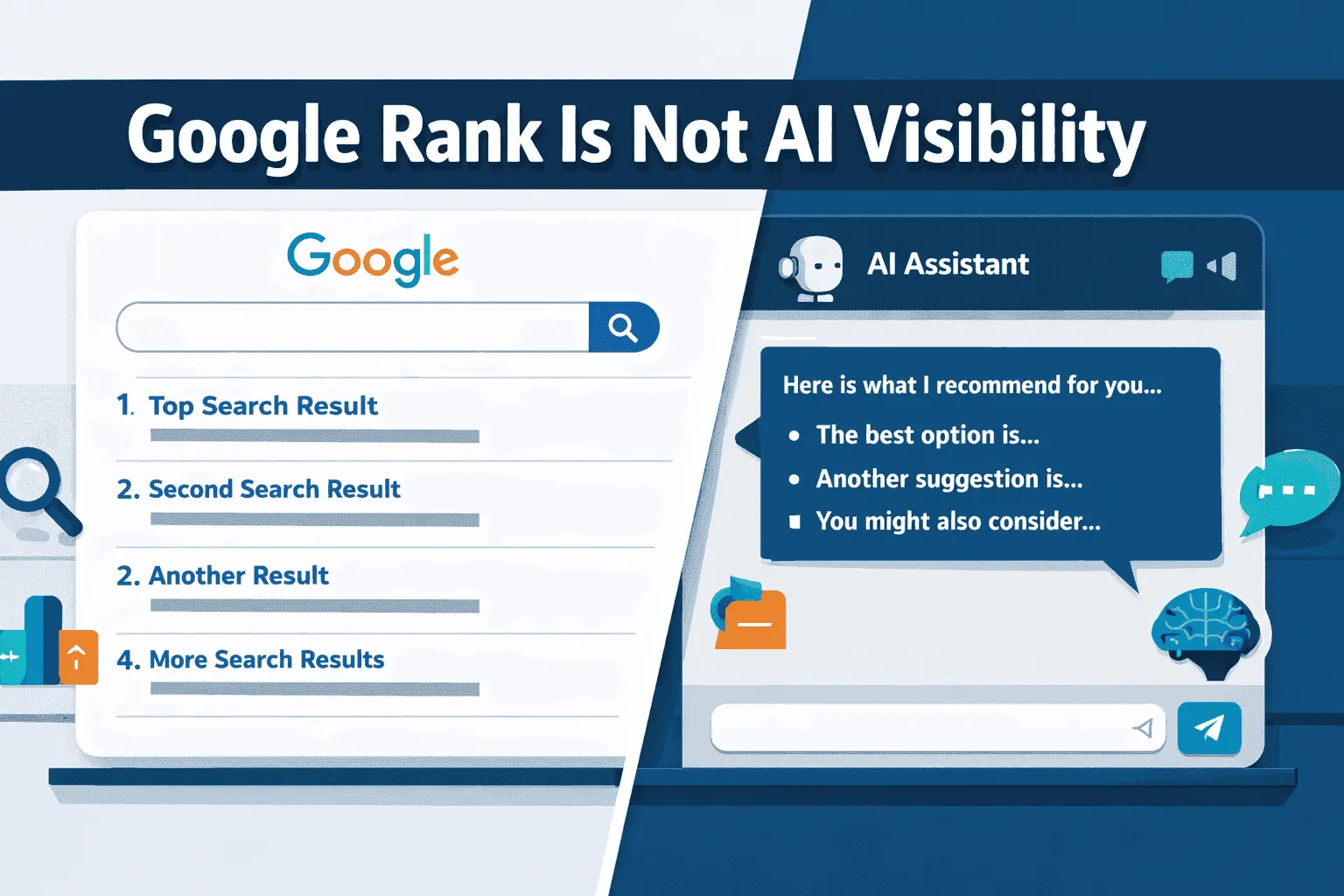
There are organizations that rank on the first page of Google for their most important keywords, generate healthy organic traffic, and have invested significantly in their SEO program — and still barely exist in the responses generated by AI systems. This is not a paradox. It is the result of a structural difference between how search engines and AI systems work that most organizations have not yet internalized.
Key Takeaways
- Google ranking and AI visibility are produced by fundamentally different mechanisms — high search rank does not transfer automatically to AI representation
- Search engines rank pages; AI systems synthesize claims — the optimization targets are different in ways that require distinct strategic approaches
- The traffic metric that defines SEO success is irrelevant to AI visibility — AI systems generate answers without sending users to websites, making traffic an incorrect proxy for AI presence
- SEO-optimized content is often poorly structured for AI synthesis — keyword density, meta descriptions, and title tag optimization do not help AI systems extract and use content
- AI systems weight source authority differently from search engines — backlink profiles matter, but the type and context of links matters more for AI than for Google
- Zero-click AI responses mean a high-ranking page may be summarized, cited, and consumed without ever generating a visit — which means the content must be designed for extraction, not just for click-through
- The organizations winning in AI visibility right now are not always the SEO leaders — they are the organizations with the most authoritative and quotable external source profiles
- Treating Google rank as a proxy for AI visibility leads to false confidence in markets where AI-mediated discovery is becoming primary
Quick Answer
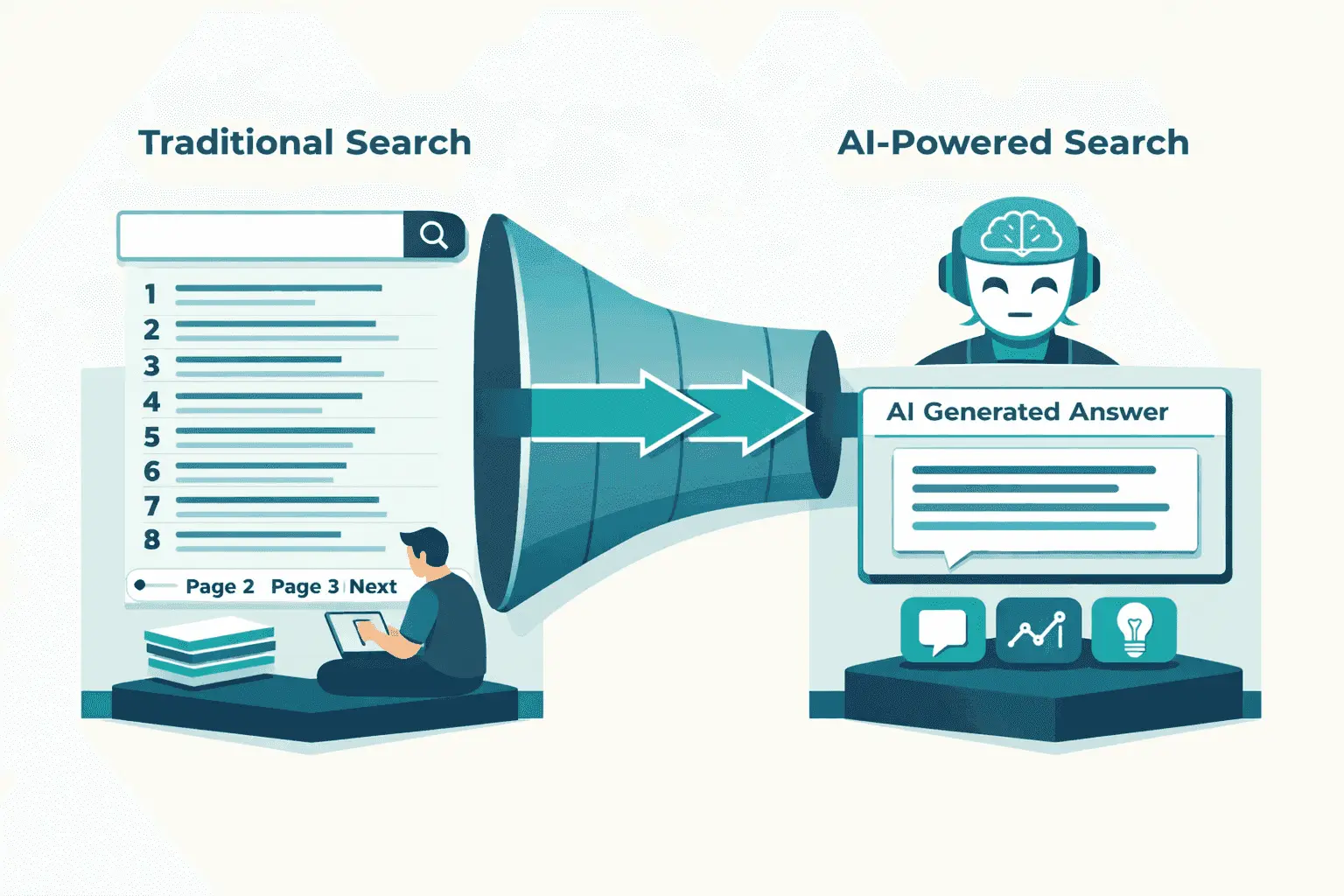
Google ranking determines where a page appears in a list of results that a user then evaluates and clicks. AI visibility determines whether and how an organization is represented in AI-generated responses that users consume directly. A page can rank first on Google and still contribute almost nothing to AI visibility if its content is keyword-optimized rather than synthesis-ready, if its source authority profile is thin outside of SEO-specific signals, or if the queries it ranks for are not the queries AI users are asking. The two outcomes require overlapping but distinct investments.
The Ranking Mechanism vs. The Synthesis Mechanism
Search engines rank. AI systems synthesize. This is the core distinction, and it has cascading implications for strategy.
When Google ranks a page, it evaluates hundreds of signals — keyword relevance, backlink authority, page experience, content quality, user engagement signals — and assigns a position in a sorted list. The user then evaluates that list, chooses which results to visit, and reads the content on the destination page. Google's job is to surface the best available options. The user's job is to evaluate them.
When an AI system generates a response, it does not produce a sorted list for user evaluation. It produces a direct answer, synthesized from source material, that it presents as a confident response to the user's query. The user typically accepts this response without visiting the sources that informed it. The AI system's job is to do the evaluation itself and deliver a conclusion.
These are different tasks requiring different inputs. Ranking benefits from click-through rate signals, user engagement patterns, and the ability to match keyword intent at scale. Synthesis benefits from quotable, specific, authoritative claims that can be extracted and combined into coherent responses.
A page optimized to rank — with keyword-dense headings, meta-optimized title tags, and content structured around search intent patterns — may be excellent at attracting clicks but poor at providing the extractable content that AI synthesis needs. A page optimized for synthesis — with direct answer statements, specific quantified claims, FAQ schema, and authoritative sourcing — may rank modestly in traditional search while contributing significantly to AI visibility.
Why High-Traffic SEO Pages Often Underperform in AI Synthesis
The characteristics of pages that achieve high search rankings are not the same as the characteristics of content that AI systems extract and reference.
Keyword optimization vs. quotability: pages that rank well are often structured around keyword phrases that match user search terms. These phrases are optimized for human reading patterns and click motivation — they make users want to click. AI systems are not motivated by click-through rate signals. They extract content that contains complete, standalone, specific statements. Keyword-dense copy that reads naturally to humans often contains few extractable statements because its sentences are constructed for flow and keyword placement rather than for standalone meaning.
Length and comprehensiveness vs. answer directness: long-form content tends to rank well in competitive search queries because it signals depth and authority. AI systems synthesizing responses to specific questions do not need 3,000-word articles — they need the 200 words that directly answer the question. Long-form pages that bury direct answers in extensive contextual material perform well in SEO and poorly in AI synthesis.
Meta description optimization: meta descriptions are written for the search results page, not for content extraction. They are designed to motivate clicks by previewing page content. AI systems do not read meta descriptions when synthesizing answers from page content. Optimizing meta descriptions has zero direct impact on AI representation.
Title tag optimization: title tags help search engines understand page topic and help users decide whether to click. AI systems typically look past title tags to the substantive content of the page. A page with an SEO-optimized title but thin, general body content will not contribute to AI visibility regardless of how well its title tag performs.
The Traffic Illusion
Perhaps the most consequential cognitive trap in AI visibility strategy is using organic traffic as a proxy for AI presence. Search traffic and AI visibility are not the same thing, and they are increasingly not even correlated.
Zero-click responses are now the dominant pattern in AI-mediated search. When a user asks an AI system a question, the system generates an answer directly. The user reads the answer and moves on — without visiting any source website. Even if a source is cited in the AI response, citation rates to click-through are low. AI representation generates awareness and trust, not traffic.
Traffic metrics are backwards-looking: they measure what has already happened via a channel that is being partially displaced. An organization that sees stable organic traffic may be experiencing declining AI visibility without that decline appearing in any traffic dashboard.
The correct measurement proxy for AI visibility is not traffic — it is representation quality. This requires actively querying AI systems with the questions your stakeholders ask and evaluating whether your organization appears, how accurately it is described, and how it is positioned relative to competitors. This cannot be automated the way traffic metrics can, which is one reason most organizations have not yet implemented it.
What Actually Differs Between Google Authority and AI Authority
While both search engines and AI systems use domain authority signals, the nature of the authority they recognize diverges in important ways.
Google weights link quantity and anchor text diversity: a large backlink profile from diverse domains, with keyword-relevant anchor text, is the primary signal for Google ranking authority. Pages with thousands of links from relevant domains rank well.
AI systems weight citation context and source type: a backlink from a community forum is an SEO signal. A mention in a Gartner research report is an AI visibility signal. The distinction is not just about domain authority in the abstract — it is about the type of source doing the mentioning. Analyst reports, academic papers, editorial journalism, and peer community discussions carry specific authority weight for AI synthesis that generic backlinks do not.
Google is largely agnostic to whether content is first-party or third-party: an organization's own website, if technically excellent and with strong backlinks, can rank highly for its target keywords. AI systems apply an independence discount to first-party content — content published by the organization about itself carries lower authority weight than content published by independent parties.
Google updates ranking continuously based on fresh signals: search ranking responds relatively quickly to new content, new links, and updated pages. AI training data updates on cycles that vary by system and may lag months or years. AI visibility in training-data systems is stickier — harder to improve quickly, but also harder to damage quickly.
The Queries That Matter
One final structural difference: the queries that matter for SEO are not the same as the queries that matter for AI visibility.
SEO targets queries that users type into search engines. These queries tend to be short, keyword-focused, and oriented toward finding a URL to visit. "Best CRM software" or "enterprise security solutions" are SEO queries.
AI visibility targets queries that users pose to conversational AI systems. These queries tend to be longer, more specific, more conversational, and oriented toward getting a direct answer. "What's the best CRM for a 50-person professional services firm that also needs project management integration" or "Does Company X have experience with pharmaceutical regulatory compliance for EU submissions?" are AI queries.
Organizations that optimize exclusively for the short-tail keyword queries that drive SEO may not be represented in the specific, long-form queries that AI users ask — even if they rank well for the SEO version of the same intent.
Mapping AI query patterns requires different research methods than keyword research. It requires understanding what questions your stakeholders actually ask conversational AI tools, not just what they type into search boxes.
FAQ
If we rank well on Google, do we automatically have some AI visibility?
Some, but not proportional to your search rank. Google-indexed content is accessible to AI retrieval systems, and strong domain authority is an input to AI source weighting. But high search rank does not guarantee accurate or prominent AI representation — especially for synthesis-oriented AI systems that prioritize content structure and quotability over keyword optimization.
Is there a correlation between search rank and AI mention frequency?
There is a loose correlation at the domain level — high-authority domains are both more likely to rank and more likely to be referenced in AI systems. But at the page and content level, the correlation breaks down. A page that ranks third for a competitive keyword may be irrelevant to AI synthesis of that topic if its content is optimized for clicks rather than extraction.
Should we stop investing in SEO to focus on GEO?
No. SEO investments build the technical and authority foundation that GEO requires. The correct approach is to ensure SEO investments also satisfy GEO requirements — by adding quotability, direct-answer structure, and FAQ schema to content that is already technically accessible and authoritative.
How do we identify the AI queries our stakeholders are using?
Interview your sales team about the questions prospects arrive having already formed opinions on. Monitor community forums in your market for questions being asked. Directly test major AI systems with the questions your target audience would ask. Use AI platforms' suggestion features to understand how queries expand.
Is local search ranking related to local AI visibility?
Yes, more directly than for non-local queries. AI systems frequently surface business recommendations for location-qualified queries, and local search ranking signals — Google Business Profile, local citations, local review volume — feed directly into local AI recommendation performance.
What is the most common mistake organizations make when they realize Google rank isn't enough?
Treating AI visibility as a separate, additive marketing channel rather than as a different measurement of the same underlying information quality. Organizations that add AI visibility tactics on top of a weak content and authority foundation see the same poor results they would get from adding any tactic without addressing foundational gaps.
References
[1] The Shift From Search Engines To Answer Engines - https://www.searchenginewatch.com/2026/01/shift-from-search-to-answer-engines/
[2] Zero Click Searches The Future Of Seo - https://moz.com/blog/zero-click-searches-future-of-seo
[3] The Rise Of Ai Search And What It Means For Seo - https://www.searchenginejournal.com/the-rise-of-ai-search-and-what-it-means-for-seo/
[4] The Death Of Traditional Seo - https://www.searchengineland.com/death-of-traditional-seo-ai-era-394523
[5] State Of Ai Search Optimization 2026 - https://www.growth-memo.com/p/state-of-ai-search-optimization-2026
[6] Generative Engine Optimization Geo Strategies - https://www.siegemedia.com/strategy/generative-engine-optimization
[7] Ai Search Analytics A Roadmap To Ai Visibility In 2026 - https://www.wpfastestcache.com/blog/ai-search-analytics-a-roadmap-to-ai-visibility-in-2026/
[8] How Ai Is Transforming Search And Discovery - https://www.forbes.com/sites/forbestechcouncil/2026/01/15/how-ai-is-transforming-search-and-discovery/
[9] Optimizing For Ai Search Engines - https://www.semrush.com/blog/ai-search-optimization/
[10] Measuring Success In The Age Of Ai Search - https://www.conductor.com/blog/measuring-ai-search-success/
About the Author
Sergio D'Alberto is the founder of ABL (AI.BUSINESS.LIFE.), an AI strategy and adoption advisory. His work focuses on helping leadership teams navigate AI governance, visibility strategy, and responsible adoption.
Prior to founding ABL, Sergio spent 16 years at Microsoft, most recently in Azure Engineering.
Related Essays
Why GEO Without SEO Is a House Without a Foundation
GEO (Generative Engine Optimization) is gaining strategic attention, but organizations that pursue it while neglecting SEO fundamentals are building on unstable ground. This essay explains why the two disciplines are interdependent — and what the right sequencing looks like.
Why Press Releases Are Invisible to AI and What Actually Builds Citation Authority
Press releases have almost no impact on AI visibility. This essay explains why the standard PR approach fails in AI-mediated contexts — and what organizations should do instead to build the citation authority that AI systems actually recognize.
Why Reddit Has Become One of the Most Important AI Visibility Assets for Your Business
Reddit is not a social media channel. For AI systems, it is a high-authority source of peer opinion, product context, and industry narrative. This essay explains why Reddit presence now shapes AI-generated business representations.