Why GEO Without SEO Is a House Without a Foundation
GEO (Generative Engine Optimization) is gaining strategic attention, but organizations that pursue it while neglecting SEO fundamentals are building on unstable ground. This essay explains why the two disciplines are interdependent — and what the right sequencing looks like.
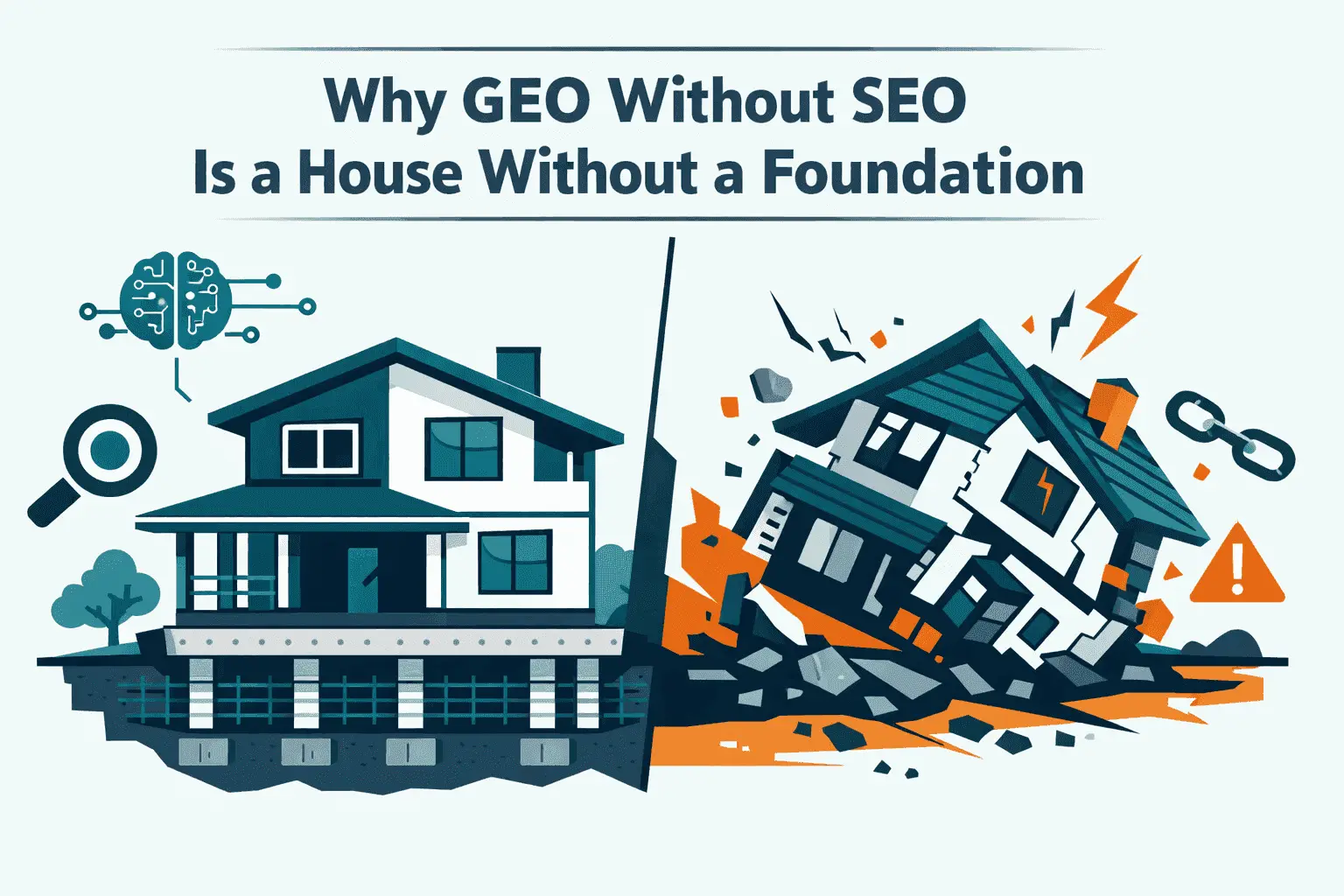
GEO — Generative Engine Optimization — has become one of the fastest-growing areas of strategic interest for marketing and communications teams. As AI systems replace search engine results pages for an increasing share of information queries, organizations want to ensure they are represented accurately in AI-generated responses. This is a legitimate strategic priority. But GEO pursued without SEO fundamentals in place is a structural mistake that produces weak results and wastes investment.
Key Takeaways
- GEO and SEO are not competing disciplines — GEO is built on the same foundational infrastructure that SEO requires, and weak SEO foundations undermine GEO outcomes
- AI systems heavily reference content that is already well-indexed and authoritative in traditional search — GEO does not provide an alternative pathway to visibility, it accelerates the results of an existing strong SEO foundation
- Technical SEO requirements — crawlability, structured data, page authority, domain authority — are prerequisites for AI system access, not optional
- Backlink profiles that signal authority to Google also signal authority to AI training systems and retrieval pipelines
- Content quality standards that rank in search — specificity, depth, quotability, E-E-A-T signals — are the same standards that make content suitable for AI synthesis
- Organizations that skip SEO fundamentals while investing in GEO tactics will see limited GEO returns because AI systems cannot access, index, or weight their content appropriately
- The correct sequencing is: technical foundation first, content authority second, GEO optimization third — not the reverse
- SEO and GEO share more than they diverge: the divergence is primarily in measurement and some content formatting choices, not in underlying infrastructure
Quick Answer
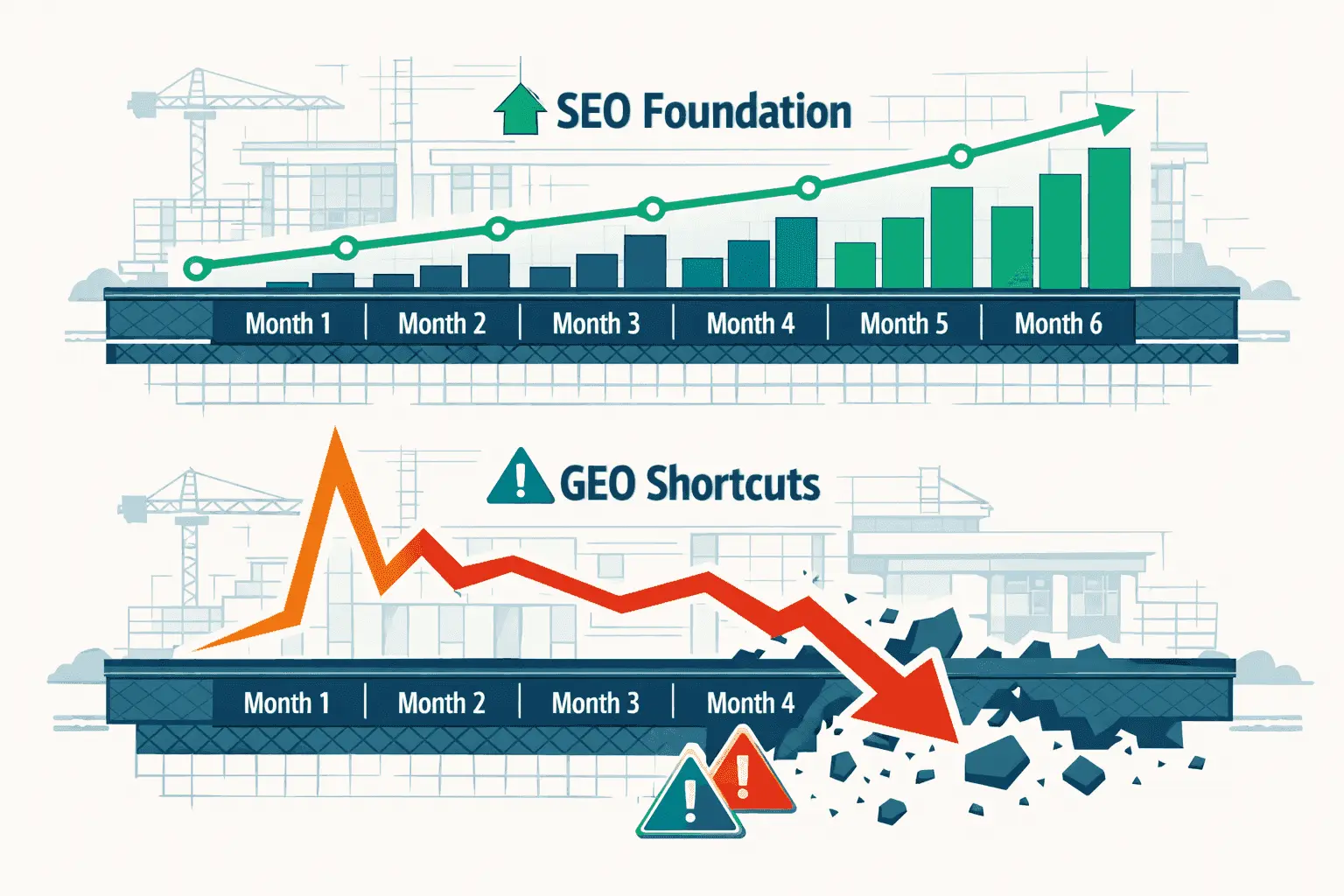
GEO optimizes content and information architecture for AI synthesis. SEO optimizes for traditional search engine indexing and ranking. The problem is that AI systems use the same signals that search engines use to evaluate source quality: domain authority, backlink profile, technical crawlability, content depth, and structured data implementation. An organization that has neglected these fundamentals cannot shortcut to GEO success by adopting new AI-targeting tactics. The foundation must come first.
The Shared Infrastructure Beneath GEO and SEO
The tendency to treat GEO as a replacement for SEO, or as a separate discipline that can be pursued independently, reflects a misunderstanding of how AI systems access and evaluate web content.
AI training crawlers and retrieval-augmented AI systems both access web content through mechanisms that are structurally similar to search engine crawlers. They fetch pages, evaluate technical accessibility, assess content quality, and weight sources based on authority signals. The authority signals they use — domain age, backlink quality, citation frequency, technical crawlability — overlap substantially with traditional SEO signals.
This is not coincidental. AI systems that were trained on web content were trained on content that had already passed through the filter of internet authority — content that had attracted links, been referenced by other sources, and been deemed worthy of crawling and indexing. The patterns AI systems learned about what constitutes authoritative, trustworthy content were shaped by the same ecosystem that SEO operates in.
The practical consequence: organizations with strong SEO foundations already have the infrastructure that GEO builds on. Organizations with weak SEO foundations face the same barriers in GEO contexts — inaccessible content, thin authority signals, poor structured data — that they face in search.
Technical SEO as GEO Prerequisite
Several technical SEO requirements are direct prerequisites for GEO effectiveness. Organizations that have deferred technical SEO work cannot achieve meaningful GEO results until those prerequisites are met.
Crawlability: AI systems cannot use content they cannot access. Pages blocked by robots.txt, pages that require JavaScript execution that AI crawlers cannot perform, pages behind authentication walls, and pages with crawl errors are invisible to AI systems regardless of their content quality. Technical SEO crawlability work is directly prerequisite to GEO accessibility.
Page speed and server response time: slow servers and pages with poor Core Web Vitals are deprioritized in crawl queues by both search engine and AI crawlers. A site with consistently slow response times will be crawled less frequently and less completely. This affects both search ranking and AI content access.
Structured data implementation: Schema.org markup is a technical SEO best practice that has become a GEO necessity. Without structured data, AI systems must infer organizational identity, content type, and information relationships from unstructured text. With it, they receive explicit machine-readable signals. Organizations that have deferred structured data implementation are at a disadvantage in both contexts.
URL structure and site architecture: logical URL hierarchies and clear site architecture help both search engines and AI systems understand the relationship between content pieces. A well-structured site allows AI systems to navigate from general organizational information to specific capability details in ways that mirror how search engines crawl and index site sections.
Domain authority and backlink profile: this is perhaps the most significant SEO prerequisite for GEO. AI training systems learned which web domains were authoritative by observing link patterns — which sites were cited, referenced, and linked to by other authoritative sites. Domains with strong backlink profiles were disproportionately represented in training data. AI systems that retrieve live web content also use domain authority signals in their source weighting. A domain with thin backlink authority will be weighted lower in AI source synthesis regardless of content quality.
Content Quality: Where SEO and GEO Requirements Converge Most Strongly
The Google Search Quality Evaluator Guidelines introduced the concept of E-E-A-T: Experience, Expertise, Authoritativeness, and Trustworthiness. These guidelines shape how Google's quality raters evaluate content and, over time, how its algorithms weight content quality.
The content characteristics that pass E-E-A-T evaluation are almost identical to the characteristics that make content suitable for AI synthesis:
Experience signals: first-hand accounts, case studies, original observations, and content that demonstrates direct engagement with the subject. AI systems prefer content that contains original evidence over content that rephrases existing sources.
Expertise signals: content written or attributed to credible domain experts, with specific and accurate technical claims. AI systems use author attribution and byline credibility as authority signals.
Authoritativeness signals: being cited by other authoritative sources, being referenced in industry discussions, and having a clear domain focus that establishes topical authority. These are identical to the citation authority signals that drive AI representation.
Trustworthiness signals: accurate, verifiable claims, transparent organizational information, absence of manipulative language, and consistency across sources. AI systems that have been trained to identify misinformation weight trustworthiness signals in source evaluation.
Organizations that have invested in E-E-A-T content quality as part of their SEO program have directly built the content characteristics that GEO requires. Organizations that have not made this investment face the same gap in both contexts.
Where GEO Diverges from SEO
Despite the shared foundation, GEO does introduce requirements that go beyond traditional SEO. Understanding these divergences helps organizations invest appropriately without over-rotating.
Quotability over keyword density: traditional SEO has historically rewarded content that includes target keywords with appropriate density and placement. GEO rewards content that contains complete, standalone, quotable statements that AI systems can extract without losing meaning. This is a formatting shift — not a structural one — but it requires deliberate content redesign.
Direct answer formatting: AI systems prefer content that answers questions directly and early, before elaborating on context and nuance. Traditional long-form SEO content often buries the direct answer in extensive context. GEO-optimized content structures answers for extraction first, depth second.
FAQ schema as a first-class element: FAQ sections with explicit schema markup are one of the highest-value GEO content investments because AI systems directly extract FAQ content for question-answering queries. Traditional SEO has treated FAQ schema as a useful enhancement; GEO treats it as a core structural requirement.
Competitive comparison framing: AI systems generate comparative analyses when users ask "what's the best X" or "how does X compare to Y." Content that explicitly addresses comparisons — stating specific differentiators, acknowledging competitive trade-offs, and framing competitive positioning clearly — is more likely to survive AI synthesis than content that avoids competitive positioning.
These are real differences, but they are formatting and framing adjustments applied on top of strong SEO foundations — not alternatives to them.
The Correct Investment Sequence
For organizations assessing how to allocate resources across SEO and GEO, the sequencing principle is clear: foundational work first.
Phase 1 — Technical foundation: ensure the site is fully crawlable, structured data is implemented across key page types, domain authority is being actively built through legitimate link acquisition, and page performance meets baseline thresholds. This work benefits both SEO and GEO equally.
Phase 2 — Content authority: build topical authority through comprehensive, expert-attributed, E-E-A-T-quality content that addresses the full question space relevant to your target audience. This content builds both search ranking and AI source presence.
Phase 3 — GEO-specific optimization: apply quotability, direct-answer formatting, FAQ schema, and competitive framing enhancements to existing high-quality content. Invest in the external citation authority building — analyst relationships, editorial coverage, community presence — that GEO uniquely requires.
Organizations that skip to Phase 3 without completing Phases 1 and 2 will find GEO tactics producing minimal results because the underlying infrastructure AI systems need to access, evaluate, and weight their content is not in place.
FAQ
Can we ignore SEO if AI search is growing?
No. AI search growth does not eliminate traditional search. A significant share of queries still go through traditional search engines. More importantly, AI systems use the same infrastructure signals as search engines — ignoring SEO means ignoring the foundation that both search and AI visibility depend on.
Is GEO just a rebranding of SEO?
No, but the overlap is substantial. GEO introduces specific requirements around quotability, answer formatting, and external citation authority that go beyond traditional SEO. However, these GEO-specific requirements sit on top of SEO foundations, not alongside them.
Which has higher ROI: investing in SEO or GEO right now?
Organizations with weak SEO foundations will see higher ROI from foundational SEO investment, because that investment improves both search and AI visibility. Organizations with strong SEO foundations should layer GEO-specific optimizations on top.
Does a strong domain authority automatically translate to good AI visibility?
It creates a significant advantage — AI systems weight high-authority domains more heavily in source retrieval. But domain authority alone does not guarantee accurate AI representation. Content quality, specificity, and external citation authority also determine representation accuracy.
How do we measure GEO performance if traditional ranking metrics don't apply?
GEO performance is measured by auditing AI system responses to queries relevant to your business: whether you are mentioned, whether the description is accurate, whether you appear in recommendation contexts, and how you are positioned relative to competitors in AI-generated comparisons.
Should we create separate content for GEO vs SEO?
In most cases, no. The better approach is to ensure existing high-quality SEO content is also formatted for GEO quotability — adding clear definitions, direct answers, FAQ sections with schema, and standalone quotable statements. Creating separate AI-targeted content as a workaround for poor SEO foundations is not effective.
Is GEO relevant for local businesses?
Yes. AI systems increasingly surface local business recommendations in response to location-qualified queries. Local SEO fundamentals — Google Business Profile, local structured data, local citation authority — directly feed local AI recommendation performance.
References
[1] Generative Engine Optimization Geo Strategies - https://www.siegemedia.com/strategy/generative-engine-optimization
[2] The Rise Of Ai Search And What It Means For Seo - https://www.searchenginejournal.com/the-rise-of-ai-search-and-what-it-means-for-seo/
[3] State Of Ai Search Optimization 2026 - https://www.growth-memo.com/p/state-of-ai-search-optimization-2026
[4] Zero Click Searches The Future Of Seo - https://moz.com/blog/zero-click-searches-future-of-seo
[5] The Death Of Traditional Seo - https://www.searchengineland.com/death-of-traditional-seo-ai-era-394523
[6] Optimizing For Ai Search Engines - https://www.semrush.com/blog/ai-search-optimization/
[7] How Ai Synthesizes Information From Multiple Sources - https://www.contentatscale.ai/blog/ai-content-synthesis/
[8] Measuring Success In The Age Of Ai Search - https://www.conductor.com/blog/measuring-ai-search-success/
[9] Ai Search Analytics A Roadmap To Ai Visibility In 2026 - https://www.wpfastestcache.com/blog/ai-search-analytics-a-roadmap-to-ai-visibility-in-2026/
[10] Creating Content For Ai Visibility - https://www.hubspot.com/marketing/ai-content-optimization
About the Author
Sergio D'Alberto is the founder of ABL (AI.BUSINESS.LIFE.), an AI strategy and adoption advisory. His work focuses on helping leadership teams navigate AI governance, visibility strategy, and responsible adoption.
Prior to founding ABL, Sergio spent 16 years at Microsoft, most recently in Azure Engineering.
Related Essays
Google Rank Is Not AI Visibility: Understanding the Fundamental Difference
Ranking well on Google does not mean AI systems know who you are. This essay maps the structural differences between search ranking and AI visibility — and why organizations that conflate them are making a costly strategic error.
Why Press Releases Are Invisible to AI and What Actually Builds Citation Authority
Press releases have almost no impact on AI visibility. This essay explains why the standard PR approach fails in AI-mediated contexts — and what organizations should do instead to build the citation authority that AI systems actually recognize.
Why Reddit Has Become One of the Most Important AI Visibility Assets for Your Business
Reddit is not a social media channel. For AI systems, it is a high-authority source of peer opinion, product context, and industry narrative. This essay explains why Reddit presence now shapes AI-generated business representations.