AI Visibility Is Not a Marketing Problem: Why It Belongs on the Leadership Agenda
AI visibility is increasingly misclassified as a marketing function. This essay explains why it is a governance and leadership issue — and what happens when organizations treat it otherwise.
Most organizations that discover they have an AI visibility problem hand it to marketing. The brief is familiar: improve our presence, fix how we show up, make sure AI tools say good things about us. It feels like brand management. It feels like a communications challenge. It is neither.
Key Takeaways
- AI visibility is a structural business condition, not a channel to be optimized by a marketing team
- Marketing cannot resolve what is fundamentally a governance gap — information architecture, narrative authority, and cross-functional consistency require executive ownership
- The consequences of poor AI visibility compound across all stakeholder categories: customers, investors, partners, and talent
- Organizations that delegate AI visibility to marketing are solving a leadership problem with the wrong instrument
- Early governance intervention is significantly more effective than reactive correction after AI systems have established inaccurate patterns
- AI systems draw from sources that marketing does not control, including industry databases, analyst reports, third-party reviews, and press archives
- Representation in AI-mediated contexts is not equivalent to brand perception — it is a factual claim that shapes decisions before any human engagement occurs
- Leadership accountability for AI visibility must be explicit, assigned, and measured — not assumed to exist because a marketing function is active
Quick Answer
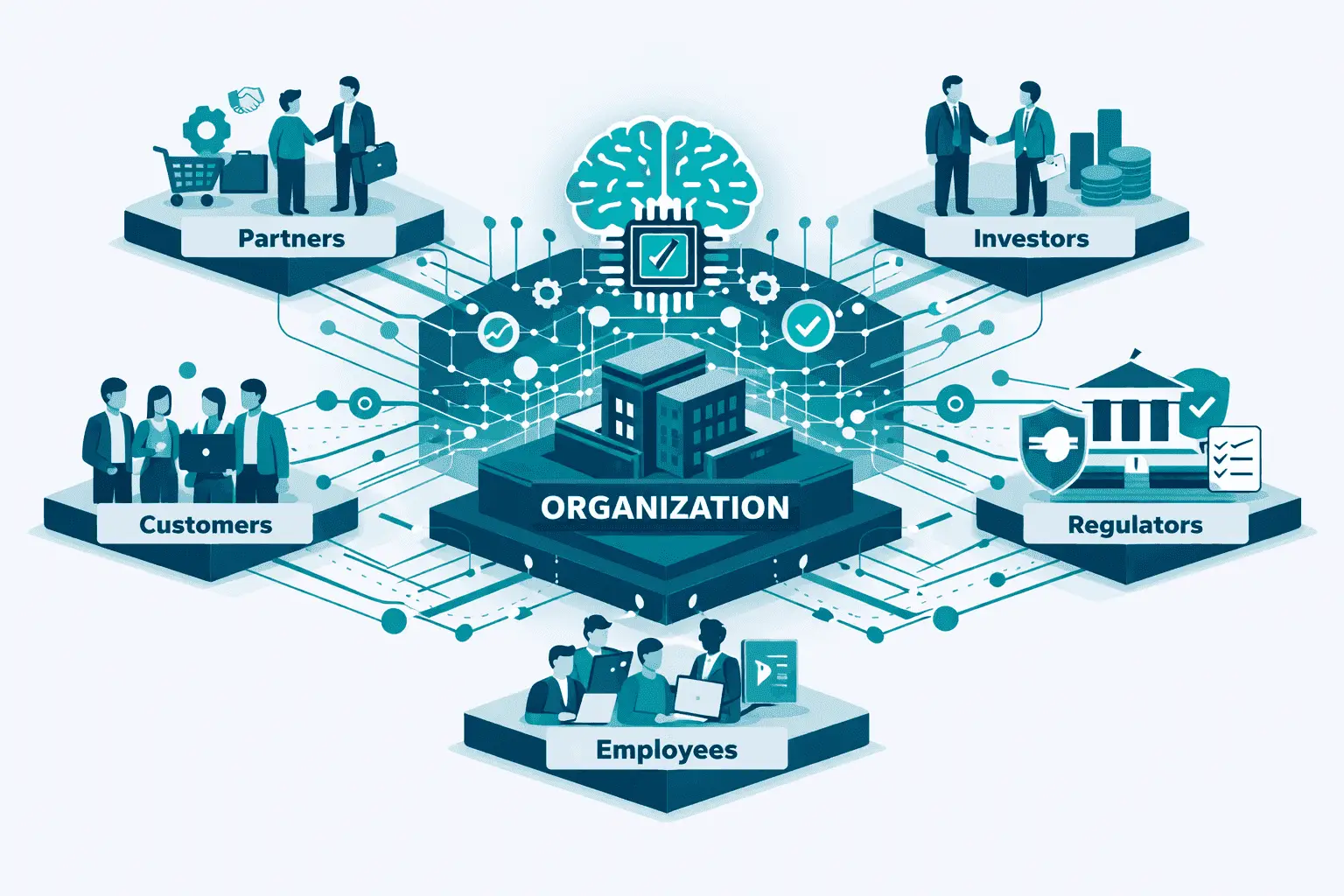
AI visibility is the condition of being accurately and consistently represented in AI-mediated decision systems. It is not a campaign. It is not content strategy. It is an institutional condition that affects how every stakeholder category — from prospective customers to investors to regulators — forms initial impressions of your organization before any human contact occurs. Marketing teams can influence content inputs, but they cannot govern the cross-functional information architecture, the source authority signals, or the strategic narrative consistency that AI systems require to represent an organization accurately. That governance belongs to leadership.
Why the Misclassification Happens
The reflex to treat AI visibility as a marketing problem is understandable. Marketing owns the website. Marketing manages brand voice. Marketing writes the content that AI systems eventually encounter. When the symptom surfaces — "AI tools aren't mentioning us" or "ChatGPT describes us incorrectly" — it looks like a content problem, and content problems belong to marketing.
This surface logic is wrong in three important ways.
First, AI systems do not primarily draw from content that marketing controls. They synthesize information from a wide range of sources: industry analyst reports, third-party review platforms, news archives, academic citations, regulatory filings, partner websites, forum discussions, and structured databases. A marketing team that publishes well-optimized content cannot compensate for incoherence in sources they don't own.
Second, the narrative that AI systems compress into summaries is a function of the entire organization's information footprint, not its marketing output. What an organization says in earnings calls, in job postings, in contracts that become public, in regulatory disclosures — all of it shapes the synthesis. Marketing cannot govern these channels.
Third, the strategic decisions required to address AI visibility — what the organization is positioned as, what it claims authority over, which categories it wants to be associated with — are not marketing decisions. They are leadership decisions. Delegating them to a marketing team creates a structural mismatch between the scope of the problem and the authority of the function assigned to solve it.
The Sources AI Systems Actually Use
Understanding why AI visibility is not a marketing problem requires a clear picture of what AI systems actually use when forming representations of organizations.
Primary reference sources include: Wikipedia and Wikidata entries, LinkedIn organization profiles, Crunchbase and Pitchbook data, industry analyst reports from Gartner, Forrester, and IDC, news coverage in established publications, regulatory and government filings, academic citations, and structured data embedded in authoritative websites.
Secondary synthesis sources include: industry forums and communities like Reddit and specialized networks, review platforms like G2 and Capterra, partner and customer testimonials, conference speaker bios and program descriptions, and podcast transcripts.
Marketing controls a small fraction of this ecosystem. The sources with highest weight — analyst reports, news coverage, regulatory filings, structured databases — are not owned by marketing and cannot be changed through content campaigns.
This is the core governance problem: the sources that matter most to AI representation sit across legal, investor relations, business development, product, and executive communications. No single function owns them. That's precisely why ownership must sit at the leadership level.
What Happens When Marketing Owns It Anyway
Organizations that assign AI visibility to marketing without leadership governance tend to follow a predictable path.
Phase 1: Content production. Marketing creates new blog posts, FAQ pages, and structured content designed to improve AI representation. Some of this helps at the margins. Core representation problems remain because the underlying source ecosystem is unchanged.
Phase 2: Measurement confusion. Marketing applies traditional metrics — traffic, rankings, engagement — to an AI visibility problem where those metrics are irrelevant. AI systems don't rank pages; they synthesize information. The feedback loop is broken and progress is difficult to assess.
Phase 3: Scope expansion without authority. As the problem persists, marketing recognizes that it needs to influence analyst relationships, press coverage, and structured database entries. These are not marketing's to change. Attempts to influence them without leadership mandate produce friction and slow results.
Phase 4: Compounding misrepresentation. While the organization runs through this cycle, AI systems continue referencing existing source material. If that material is outdated, incomplete, or inconsistent, the misrepresentation compounds. AI systems that reference previous AI-generated summaries entrench inaccurate characterizations further.
The cost of this cycle is not just wasted marketing effort. It is the accumulation of misrepresentation in systems that influence how your next customer, your next investor, and your next key hire forms their first impression of your organization.
The Leadership Governance Model
Effective AI visibility governance requires an explicit ownership structure at the leadership level. This does not mean the CEO writes content. It means that the strategic decisions underlying AI representation are made at the appropriate level and executed cross-functionally.
Strategic narrative ownership must sit with leadership. What is this organization positioned as? What categories does it lead? What claims can it make with authority? These decisions shape every source that AI systems reference.
Cross-functional coordination requires executive mandate. Ensuring that analyst briefings, investor communications, product documentation, and marketing content tell a consistent story is not a marketing task. It requires someone with authority to align functions that don't normally coordinate on narrative.
Source authority strategy requires business development and communications working together. Getting accurately represented in analyst reports, structured databases, and industry publications requires relationships and investment that operate at an organizational level, not a campaign level.
Monitoring and correction requires defined accountability. Someone must own the question: what do AI systems currently say about us, and is it accurate? This is not a quarterly marketing report. It is an ongoing governance function.
Response protocols must be defined before misrepresentations compound. When AI systems describe the organization inaccurately in ways that affect stakeholder decisions, there must be a clear process for identifying the source of the error, correcting the upstream information, and monitoring improvement.
The Cost of Waiting
The irreversibility argument is the most important reason AI visibility must be on the leadership agenda now. AI systems don't just reflect current information — they compound it. When a representation is established across multiple sources and referenced by subsequent AI-generated summaries, correcting it becomes significantly more complex than establishing it correctly from the start.
Organizations that act early shape their own AI narrative. Organizations that wait inherit one.
The compounding effect means that the gap between organizations with active AI visibility governance and those without grows over time. Competitors who establish clear, accurate, consistent representation in AI systems gain systematic advantages in every AI-mediated discovery context — vendor searches, investor research, talent sourcing, partner evaluation. These advantages are not one-time; they recur across every decision made with AI assistance.
For organizations in competitive markets, the leadership question is not whether to address AI visibility. It is whether to address it before or after the competitive gap becomes visible in revenue outcomes.
Assigning Ownership Correctly
The practical question is: who owns this? The answer depends on organizational structure, but the principles are consistent.
The owner must have cross-functional authority — the ability to convene and align legal, communications, investor relations, marketing, product, and business development without requiring a separate escalation for each alignment.
The owner must have strategic context — understanding of how the organization is positioned, where it is heading, and what narrative it needs AI systems to carry into decision contexts.
The owner must have a mandate for ongoing governance, not just a one-time audit. AI visibility is not a project with an end date. It is a condition that requires maintenance as AI systems evolve, the competitive landscape shifts, and the organization's own strategy develops.
In most organizations, this points to a Chief Marketing Officer with expanded scope, a Chief Strategy Officer, or a direct mandate from the CEO. What it does not point to is a content manager, a digital marketing team, or any function whose authority stops at the boundaries of owned marketing channels.
FAQ
Why can't marketing solve AI visibility on its own?
Marketing controls a fraction of the sources AI systems use to form organizational representations. Analyst reports, regulatory filings, news archives, structured databases, and partner content all carry more weight in AI synthesis than marketing-owned content, and none of them are within marketing's authority to change without cross-functional coordination.
What specific leadership actions improve AI visibility?
Establishing a consistent strategic narrative across all organizational communications, investing in analyst relationships that shape AI source material, ensuring structured data and third-party database entries are accurate and current, and defining monitoring and correction protocols for misrepresentation.
How does AI visibility affect investor relations?
Investors increasingly use AI tools for initial company research. Organizations misrepresented in AI systems face inaccurate investor summaries before any direct engagement occurs. This affects perception of capabilities, competitive positioning, and growth trajectory during early-stage evaluation.
Is AI visibility the same as GEO or AEO?
GEO (Generative Engine Optimization) and AEO (AI Engine Optimization) are tactical disciplines focused on optimizing content for AI synthesis. AI visibility governance is the strategic layer above those tactics — defining what the organization should be represented as and ensuring the full source ecosystem supports that representation.
How do we measure whether leadership governance is working?
Track representation accuracy across major AI platforms by querying them regularly with questions your stakeholders would ask. Measure consistency between intended strategic positioning and AI-generated descriptions. Monitor competitive positioning in AI-mediated comparisons. These are qualitative and strategic metrics, not traffic or ranking metrics.
How frequently should AI representation be audited?
Quarterly audits across major AI platforms provide a baseline. Additional spot checks are warranted after strategic pivots, major announcements, significant news coverage, or when competitive dynamics shift.
What is the first step for a leadership team starting from scratch?
Conduct a structured audit of what major AI systems currently say about your organization across the decision contexts that matter most to your stakeholders. Map the gap between current representation and accurate representation. Identify which sources are driving the gap. That analysis determines whether the problem is a content problem, a source authority problem, or a narrative coherence problem — and routes ownership accordingly.
Does company size affect the urgency of this issue?
Smaller companies face a different version of the problem. They are often absent from AI-generated summaries entirely, rather than misrepresented. This structural invisibility is just as damaging in markets where AI-mediated discovery is common. Leadership governance is equally important at any scale.
References
[1] Ai Visibility Tracking Small Teams Complete Guide - https://almcorp.com/blog/ai-visibility-tracking-small-teams-complete-guide/
[2] Brand Visibility In The Age Of Ai - https://mcfadyen.com/articles/brand-visibility-in-the-age-of-ai/
[3] State Of Ai Search Optimization 2026 - https://www.growth-memo.com/p/state-of-ai-search-optimization-2026
[4] Ai Tech Trends Predictions 2026 - https://www.ibm.com/think/news/ai-tech-trends-predictions-2026
[5] How Ai Is Transforming Search And Discovery - https://www.forbes.com/sites/forbestechcouncil/2026/01/15/how-ai-is-transforming-search-and-discovery/
[6] Generative Engine Optimization Geo Strategies - https://www.siegemedia.com/strategy/generative-engine-optimization
[7] The Shift From Search Engines To Answer Engines - https://www.searchenginewatch.com/2026/01/shift-from-search-to-answer-engines/
[8] Marketing Trends - https://www.kantar.com/campaigns/marketing-trends
[9] Ai Search Analytics A Roadmap To Ai Visibility In 2026 - https://www.wpfastestcache.com/blog/ai-search-analytics-a-roadmap-to-ai-visibility-in-2026/
[10] Creating Content For Ai Visibility - https://www.hubspot.com/marketing/ai-content-optimization
About the Author
Sergio D'Alberto is the founder of ABL (AI.BUSINESS.LIFE.), an AI strategy and adoption advisory. His work focuses on helping leadership teams navigate AI governance, visibility strategy, and responsible adoption.
Prior to founding ABL, Sergio spent 16 years at Microsoft, most recently in Azure Engineering.
Related Essays
AI Visibility and Representation: The Executive Discipline for AI-Mediated Business Decisions
As AI systems mediate business decisions affecting all stakeholder relationships, AI Visibility and Representation requires board-level governance beyond traditional marketing scope.
The Representation Risk in AI: Why Inaccurate AI Descriptions of Your Business Compound Over Time
Being visible to AI systems is not enough. Inaccurate AI representations of your business create compounding stakeholder harm. This essay explains the mechanics of representation risk and how to address it before the damage becomes structural.
Your Business Exists in AI's Memory. You Just Don't Know What It Says.
Every business that has generated any online presence exists in AI systems in some form. The question is not whether AI has a version of your business — it is whether that version is accurate, useful, and competitive. Most organizations have never checked.