When AI Chooses for Your Customer: The Rise of AI-Mediated Decisions
How AI systems increasingly mediate business decisions before human engagement, creating new governance imperatives for organizational visibility and competitive positioning.
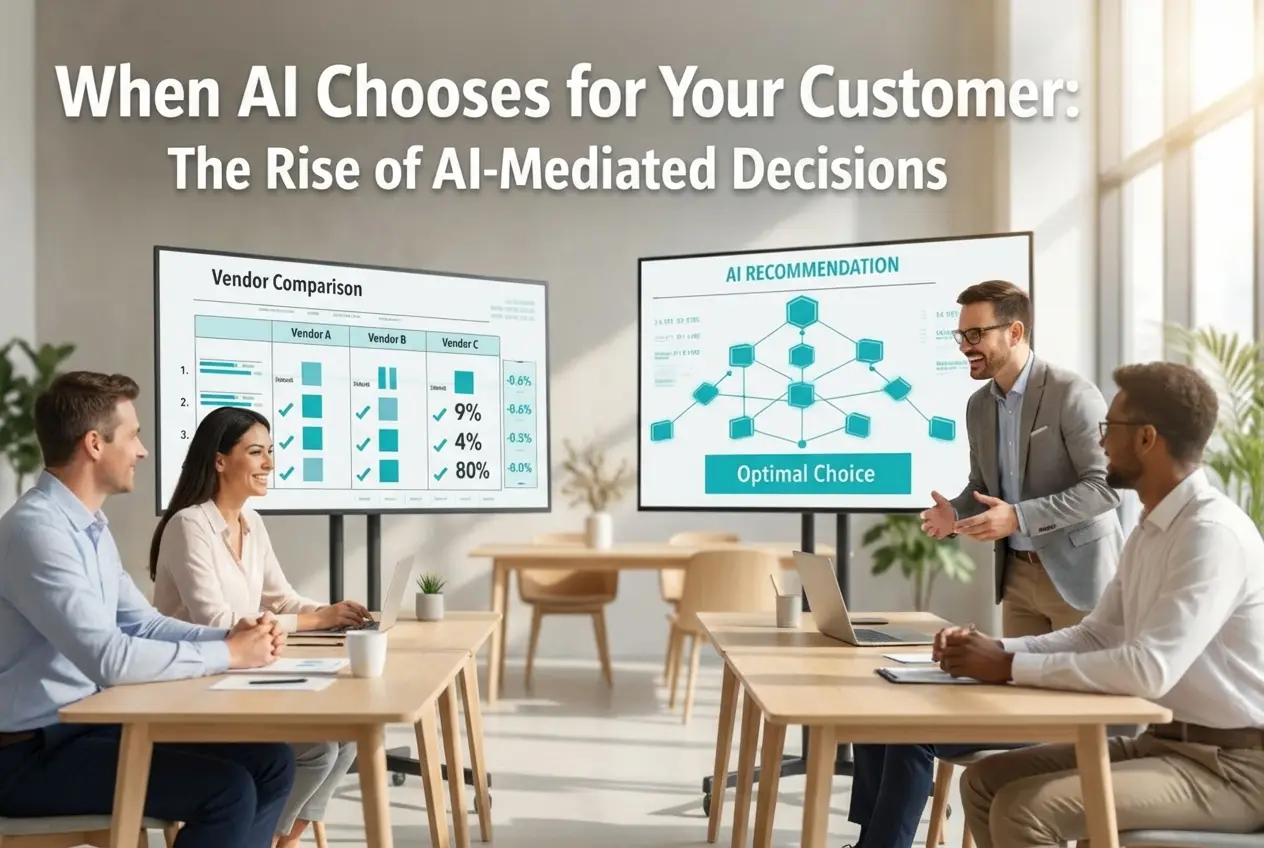
Your next customer may never visit your website first. Instead, an AI system will evaluate, compare, and recommend your organization before any human decision-maker knows your company exists. This represents a fundamental shift from customers finding you to AI systems choosing you.
Key Takeaways
- AI systems increasingly act as pre-decision layers, filtering and comparing vendors before human engagement
- Traditional search behavior is giving way to AI synthesis, where systems provide answers rather than links
- Vendor selection processes now include AI-assisted evaluation at multiple decision points
- Narrative compression occurs when AI systems summarize complex organizations into brief comparisons
- Decision-system exposure becomes a governance responsibility, not just a marketing function
- Procurement leaders rely on AI recommendations for initial vendor shortlisting in 81% of technology purchases
- Structural invisibility emerges when organizations lack representation in AI-mediated decision flows
- Executive accountability extends to how AI systems interpret and present organizational capabilities
Quick Answer
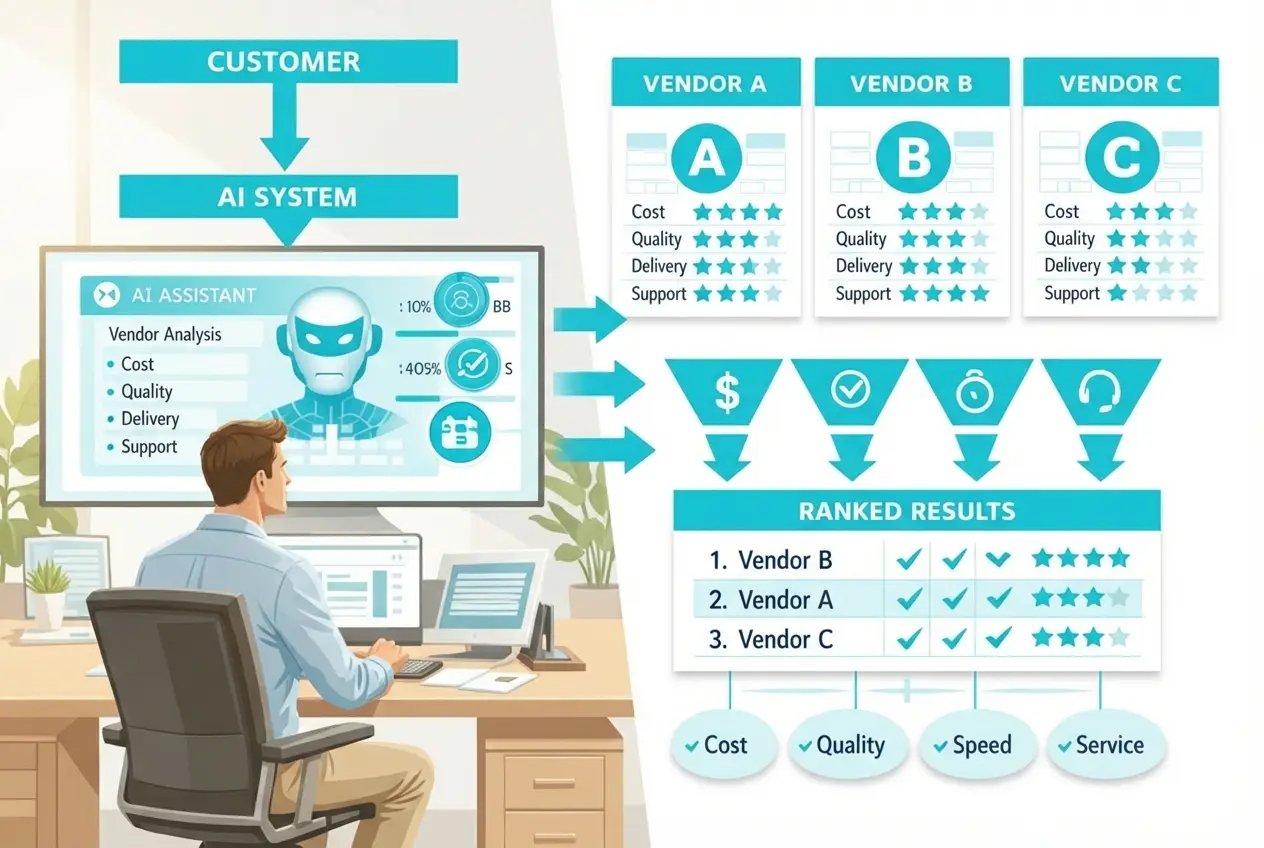
AI-mediated decisions occur when artificial intelligence systems evaluate, filter, compare, and recommend options before human decision-makers engage directly with vendors or service providers. This shift moves AI from a search tool to a decision-shaping intermediary that influences which organizations enter consideration sets and how they are perceived during evaluation processes.
How AI Systems Function as Decision Intermediaries
AI systems no longer simply retrieve information. They synthesize, compare, and recommend before presenting options to human decision-makers. This transformation creates a new layer between organizations and their potential customers.
When a procurement leader asks an AI system to identify top vendors in cybersecurity, the AI doesn't provide a list of links. Instead, it delivers a structured comparison highlighting key differentiators, pricing considerations, and implementation timelines. The AI system becomes the first evaluator of vendor capabilities.
This mediation occurs across multiple business contexts:
- Vendor evaluation: AI systems compare capabilities, pricing, and fit before human review
- Service selection: AI recommends solutions based on specific organizational requirements
- Supplier assessment: AI evaluates compliance, performance history, and risk factors
- Technology procurement: AI matches technical specifications with vendor offerings
The economic impact centers on inclusion versus exclusion. Organizations that AI systems cannot adequately represent or compare face structural disadvantage in reaching decision-makers.
Common mistake: Assuming AI systems operate like search engines. They don't rank results; they interpret and synthesize information into recommendations.
The Shift from Search to AI-Mediated Synthesis
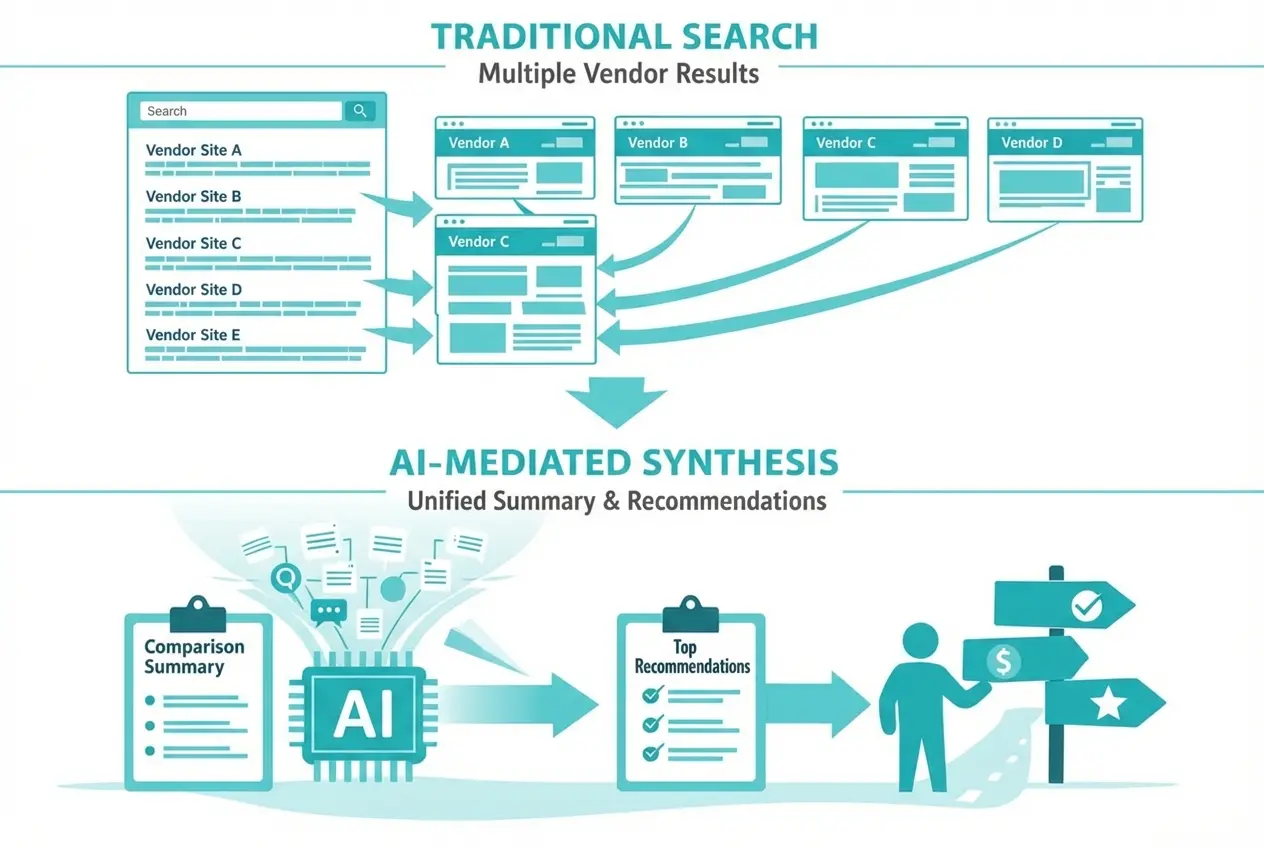
Traditional search required customers to evaluate multiple sources independently. AI-mediated decisions compress this evaluation process into pre-filtered recommendations and comparisons.
Search behavior involved: Query submission, result scanning, website evaluation, comparison across multiple sources, and independent decision-making.
AI-mediated behavior involves: Query submission, AI evaluation of sources, synthesized comparison delivery, and decision-making based on AI interpretation.
This shift changes how organizations must think about customer acquisition:
Traditional Model Assumptions
- Customers visit websites directly
- Marketing controls first impressions
- SEO determines visibility
- Brand messaging reaches customers unfiltered
AI-Mediated Model Realities
- AI systems interpret organizations before customer contact
- AI synthesis shapes first impressions
- Decision-system exposure determines inclusion
- AI interpretation filters brand messaging
Key insight: Organizations optimized for human discovery may lack adequate representation in AI-mediated decision flows.
The governance implication is significant. Marketing departments cannot solve structural representation challenges through traditional tactics. This requires leadership-level attention to how AI systems access, interpret, and present organizational information.
Executive Scenarios: AI-Mediated Decisions in Practice
Understanding AI-mediated decisions requires examining specific scenarios where AI systems influence business outcomes before human engagement occurs.
Scenario 1: Procurement AI Shortlisting
A Chief Procurement Officer uses an AI system to identify potential vendors for enterprise software implementation. The AI evaluates hundreds of potential vendors against specific criteria: industry experience, implementation timeline, compliance certifications, and budget parameters.
The AI delivers: Three recommended vendors with comparative analysis, implementation risk assessment, and budget impact projections.
The business impact: Vendors not adequately represented in AI-accessible information sources never enter consideration, regardless of actual capabilities.
Scenario 2: Competitive Intelligence Synthesis
A strategy team asks AI to compare their organization against three competitors for a board presentation. The AI synthesizes publicly available information, case studies, and performance indicators into a structured comparison.
The AI delivers: Competitive positioning analysis highlighting strengths, weaknesses, market perception, and differentiation factors.
The representation risk: Organizations with limited AI-accessible information appear less capable than competitors with comprehensive digital representation.
Scenario 3: Investment Due Diligence Support
An investment committee uses AI to evaluate potential portfolio companies. The AI analyzes financial performance, market position, competitive landscape, and growth trajectory across multiple candidates.
The AI delivers: Investment recommendation with risk assessment, growth potential scoring, and comparative market analysis.
The governance challenge: Companies without structured, AI-accessible information face disadvantaged evaluation compared to those with comprehensive digital presence.
Scenario 4: Autonomous Agent Vendor Selection
An AI agent operating on behalf of a facilities manager autonomously evaluates and selects vendors for routine maintenance contracts based on predefined criteria: cost, availability, performance history, and compliance status.
The AI delivers: Vendor selection and contract initiation without human intervention for routine procurement decisions.
The structural implication: Organizations invisible to AI agents lose access to entire categories of business opportunities.
The Economics of Narrative Compression
AI systems compress complex organizational narratives into brief, comparable summaries. This compression process determines how decision-makers initially perceive organizations and whether they advance to deeper evaluation.
Narrative compression occurs when AI systems:
- Summarize company capabilities in 2-3 sentences
- Extract key differentiators from extensive content
- Compare organizations using standardized criteria
- Highlight specific strengths relevant to user queries
The challenge lies in representation accuracy. Organizations with comprehensive, structured information receive more accurate AI representation than those with limited or poorly organized digital presence.
Example of effective representation: "TechCorp specializes in healthcare cybersecurity with 15 years of HIPAA compliance experience, serving 200+ hospitals across North America. Their platform reduces security incidents by 40% compared to industry averages and includes 24/7 monitoring with 4-hour response guarantees."
Example of poor representation: "TechCorp provides cybersecurity services to various industries. They offer monitoring and compliance solutions with customer support."
The economic difference between these representations is substantial. The first version positions TechCorp as a specialized, experienced vendor with quantifiable value. The second version presents a generic service provider without clear differentiation.
Decision rule: Organizations with specific, quantifiable, and accessible information receive more favorable AI representation than those with generic or limited digital presence.
Governance Implications for Decision-System Exposure
AI-mediated decisions create new governance responsibilities that extend beyond traditional marketing and communications functions. Leadership teams must address how AI systems access, interpret, and present organizational information.
Executive Accountability Areas
Information Architecture: How organizational information is structured for AI interpretation Representation Accuracy: Whether AI systems accurately convey organizational capabilities Decision-System Coverage: Which AI platforms and systems can access organizational information Narrative Consistency: How organizational messaging translates across different AI interpretations Competitive Positioning: How AI systems compare the organization against competitors
Governance Framework Components
Organizations require systematic approaches to managing AI representation:
- Audit current AI representation across major platforms and systems
- Identify representation gaps where organizational information is incomplete or inaccurate
- Establish information standards for AI-accessible content and data
- Monitor competitive positioning in AI-mediated comparisons
- Develop response protocols for representation issues and inaccuracies
Critical insight: Marketing departments cannot address structural representation challenges independently. This requires cross-functional coordination involving legal, compliance, operations, and executive leadership.
The governance responsibility centers on ensuring organizational information is accessible, accurate, and competitive within AI-mediated decision environments.
Measuring Impact of AI-Mediated Decisions
Organizations must develop new metrics to understand how AI-mediated decisions affect business outcomes. Traditional marketing metrics provide incomplete visibility into AI-influenced customer acquisition and competitive positioning.
Key Performance Indicators
Decision-System Inclusion Rate: Percentage of relevant AI queries where the organization appears in recommendations Representation Accuracy Score: How accurately AI systems convey organizational capabilities and differentiators Competitive Positioning Index: Relative ranking and representation quality compared to key competitors Conversion from AI Referral: Business outcomes generated from AI-mediated introductions Narrative Consistency Measure: Alignment between intended messaging and AI interpretation
Measurement Challenges
Traditional analytics tools cannot track AI-mediated decision flows. Organizations require new approaches to understand:
- Which AI systems influence their target customers
- How accurately those systems represent organizational capabilities
- What information gaps create competitive disadvantages
- How AI interpretation affects customer perception and engagement
Measurement framework: Regular AI representation audits, competitive positioning analysis, and correlation tracking between AI visibility and business outcomes.
The measurement challenge reflects the broader governance shift. Organizations must invest in understanding AI-mediated decision flows the same way they historically invested in understanding search engine optimization and digital marketing effectiveness.
Strategic Response Framework
Organizations require structured approaches to address AI-mediated decision challenges. This involves assessment, optimization, and ongoing governance of AI representation.
Phase 1: Assessment and Audit
Conduct AI representation audit across major platforms and decision-support systems Analyze competitive positioning in AI-mediated comparisons Identify information gaps that limit accurate AI interpretation Evaluate current decision-system exposure across target customer segments
Phase 2: Information Architecture Optimization
Structure organizational information for AI accessibility and interpretation Develop standardized content formats that support accurate AI synthesis Establish data quality standards for AI-accessible information Create comprehensive capability documentation that enables accurate AI representation
Phase 3: Monitoring and Governance
Implement ongoing AI representation monitoring across relevant platforms Establish response protocols for representation inaccuracies or competitive disadvantages Develop cross-functional governance involving marketing, legal, operations, and executive leadership Create performance measurement systems that track AI-mediated business impact
The strategic response must address both immediate representation challenges and long-term governance requirements as AI systems become more prevalent in business decision-making.
Industry-Specific Considerations for AI-Mediated Decisions
Different industries face varying levels of AI mediation in customer decision-making processes. Understanding industry-specific patterns helps organizations prioritize their response strategies.
Technology and Software
High AI mediation impact: 81% of technology buyers now prioritize ethical AI use when selecting vendors, indicating AI-assisted evaluation of vendor AI practices.
Key considerations: Technical specifications, compliance certifications, integration capabilities, and performance benchmarks must be AI-accessible and comparable.
Professional Services
Moderate AI mediation impact: AI systems increasingly evaluate service providers based on expertise areas, client results, and industry experience.
Key considerations: Case studies, outcome metrics, and specialized capabilities require structured presentation for accurate AI interpretation.
Healthcare and Life Sciences
Emerging AI mediation: 69% of consumers remain uncomfortable with AI for medical advice, but procurement decisions for healthcare technology show increasing AI assistance.
Key considerations: Regulatory compliance, clinical evidence, and safety profiles must be comprehensively documented for AI evaluation.
Financial Services
Complex AI mediation: 68% of consumers are uncomfortable with AI for investment advice, but institutional procurement increasingly uses AI-assisted vendor evaluation.
Key considerations: Regulatory compliance, risk management capabilities, and performance history require detailed, AI-accessible documentation.
Industry insight: Sectors with high regulatory requirements face additional complexity in AI representation, as compliance information must be both comprehensive and accessible to AI systems.
Future Implications: Agentic Systems and Autonomous Decisions
The evolution toward autonomous AI agents represents the next phase of AI-mediated decisions. These systems will make procurement and vendor selection decisions with minimal human oversight for routine business functions.
Agentic System Characteristics
Autonomous decision-making: AI agents will select vendors, negotiate contracts, and manage supplier relationships independently Predefined criteria execution: Agents operate within established parameters for cost, quality, compliance, and performance Continuous optimization: Systems learn from outcomes and adjust vendor selection criteria over time Integration with business systems: Agents access procurement, financial, and operational data to inform decisions
Organizational Implications
Organizations must prepare for environments where AI agents make initial vendor selections without human involvement. This requires:
Comprehensive digital representation that enables accurate agent evaluation Structured information architecture that supports automated decision-making Clear value proposition articulation that differentiates offerings in agent comparisons Compliance and certification documentation that meets automated verification requirements
Strategic consideration: Organizations invisible to AI agents will lose access to significant business opportunities as autonomous procurement becomes standard practice.
The governance challenge intensifies as decision-making becomes more automated. Organizations require proactive strategies to ensure appropriate representation in agent-mediated business environments.
FAQ
What are AI-mediated decisions?
AI-mediated decisions occur when artificial intelligence systems evaluate, compare, and recommend options before human decision-makers engage with vendors or service providers. The AI acts as an intermediary that shapes which organizations enter consideration and how they are initially perceived.
How do AI-mediated decisions differ from traditional search?
Traditional search provides lists of results for human evaluation. AI-mediated decisions provide synthesized comparisons and recommendations based on AI interpretation of multiple sources. The AI makes initial evaluations rather than simply retrieving information.
Which industries are most affected by AI-mediated decisions?
Technology and software sectors show the highest impact, with 81% of buyers prioritizing ethical AI use in vendor selection. Professional services, healthcare technology procurement, and financial services also show increasing AI mediation in decision processes.
Who is responsible for managing AI representation in organizations?
AI representation requires cross-functional governance involving marketing, legal, operations, and executive leadership. This is not solely a marketing responsibility but a strategic governance issue requiring leadership-level attention.
How can organizations measure AI-mediated decision impact?
Organizations should track decision-system inclusion rates, representation accuracy, competitive positioning in AI comparisons, and business outcomes from AI referrals. Traditional marketing metrics provide incomplete visibility into AI-influenced customer acquisition.
What information do AI systems need for accurate representation?
AI systems require structured information about capabilities, differentiators, performance metrics, compliance certifications, and specific expertise areas. Generic or poorly organized information results in inadequate AI representation.
How do AI agents differ from current AI-mediated decisions?
AI agents will make autonomous vendor selections with minimal human oversight, while current AI-mediated decisions primarily support human decision-making. Agents represent full automation of routine procurement and vendor selection processes.
What are the risks of poor AI representation?
Organizations with inadequate AI representation face structural invisibility in decision processes, reduced inclusion in vendor evaluations, and competitive disadvantage compared to organizations with comprehensive digital presence.
How often should organizations audit their AI representation?
Organizations should conduct quarterly AI representation audits across major platforms and decision-support systems, with more frequent monitoring during competitive campaigns or market expansion initiatives.
Can organizations control how AI systems represent them?
Organizations cannot directly control AI interpretation but can influence representation through comprehensive, structured information architecture and consistent digital presence across platforms that AI systems access.
What is narrative compression in AI-mediated decisions?
Narrative compression occurs when AI systems summarize complex organizational capabilities into brief, comparable statements. This compression determines how decision-makers initially perceive organizations and whether they advance to deeper evaluation.
How do AI-mediated decisions affect competitive positioning?
AI systems compare organizations using standardized criteria, making relative positioning more transparent and quantifiable. Organizations with superior AI representation gain competitive advantages in initial evaluation processes.
References
[1] Customer Service Statistics - https://www.surveymonkey.com/curiosity/customer-service-statistics/
[2] Customer Service Statistics - https://www.amplifai.com/blog/customer-service-statistics
[3] 18 Customer Experience Predictions For 2026 - https://www.adrianswinscoe.com/2025/12/18-customer-experience-predictions-for-2026/
[4] Ai Customer Service Statistics - https://www.zendesk.com/blog/ai-customer-service-statistics/
[5] Ces 2026 - https://www.kantar.com/north-america/inspiration/advertising-media/ces-2026
[6] Introducing The Consumer Ai Disruption Index - https://www.bcg.com/publications/2026/introducing-the-consumer-ai-disruption-index
[7] The Top Consumer Ai Trends Of 2026 - https://www.suzy.com/blog/the-top-consumer-ai-trends-of-2026
[8] The Trends Shaping Data And Ai In 2026 - https://www.gofurther.com/blog/the-trends-shaping-data-and-ai-in-2026
[9] Ai Update February 20 2026 Ai News And Views From The Past Week - https://www.marketingprofs.com/opinions/2026/54328/ai-update-february-20-2026-ai-news-and-views-from-the-past-week
[10] Ai Mediated Buying Journeys How Buyers Decide Whos Worth Their Time - https://www.idc.com/resource-center/blog/ai-mediated-buying-journeys-how-buyers-decide-whos-worth-their-time/
About the Author
Sergio D'Alberto is the founder of ABL (AI.BUSINESS.LIFE.), an AI strategy and adoption advisory. His work focuses on helping leadership teams navigate AI governance, visibility strategy, and responsible adoption.
Prior to founding ABL, Sergio spent 16 years at Microsoft, most recently in Azure Engineering.
Related Essays
AI Visibility Is Not a Marketing Problem: Why It Belongs on the Leadership Agenda
AI visibility is increasingly misclassified as a marketing function. This essay explains why it is a governance and leadership issue — and what happens when organizations treat it otherwise.
The Representation Risk in AI: Why Inaccurate AI Descriptions of Your Business Compound Over Time
Being visible to AI systems is not enough. Inaccurate AI representations of your business create compounding stakeholder harm. This essay explains the mechanics of representation risk and how to address it before the damage becomes structural.
What AI Actually Does When a Customer Asks for a Recommendation About Your Business
Most organizations have no idea what happens inside an AI system when a customer asks about them. This essay maps the mechanics of AI recommendation generation — and what organizations must do to influence the outcome.