AI Does Not Rank. It Rewrites.
Understanding the fundamental shift from ranked search results to AI-synthesized answers and what this means for organizational visibility and competitive positioning.
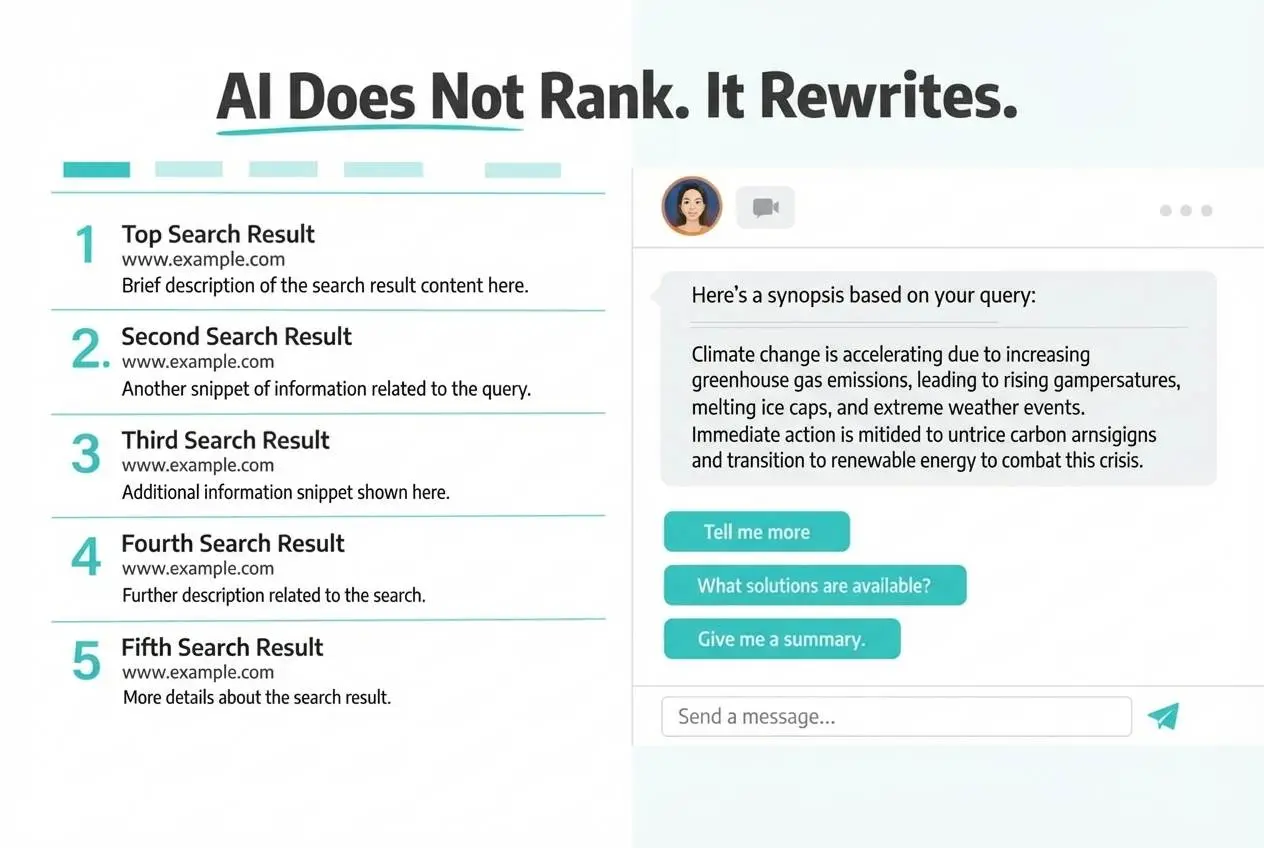
Traditional search engines ranked websites and presented lists for human evaluation. AI systems synthesize information from multiple sources and generate direct answers. This shift from ranking to rewriting fundamentally changes how organizations must approach visibility, competitive positioning, and content strategy.
Key Takeaways
- AI systems synthesize rather than rank, creating original text that combines information from multiple sources
- Zero-click searches now dominate, with approximately 60% of searches ending without clicks to external sites
- Source selection happens before synthesis, making authoritative source presence more critical than page ranking
- Quotability determines usage, as AI systems extract specific statements rather than summarize entire pages
- Narrative control shifts from organizations to AI interpretation, requiring different content strategies
- Traditional SEO metrics become inadequate for measuring AI-mediated visibility
- Citation patterns in AI responses reveal which sources AI systems trust and reference
- Organizations must optimize for synthesis rather than ranking, fundamentally changing content development approaches
Quick Answer
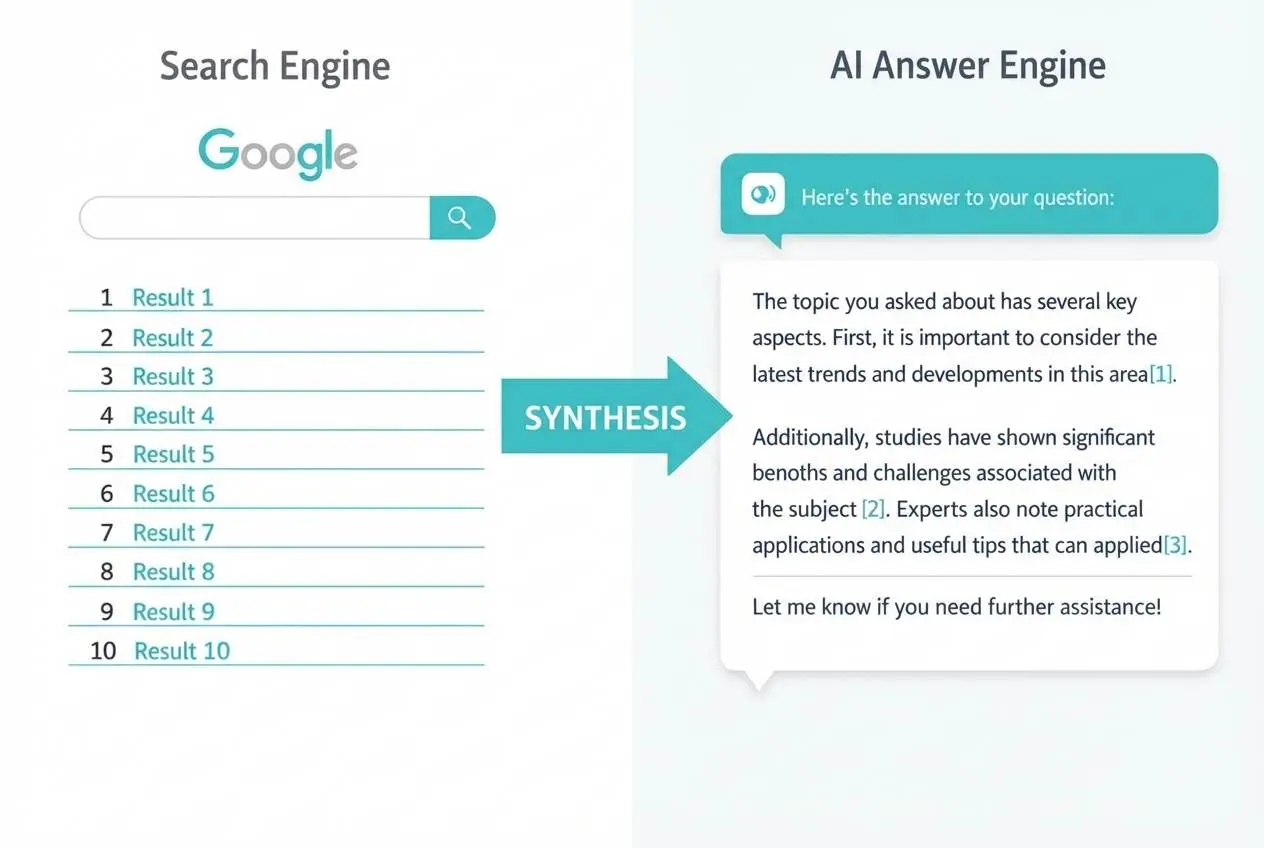
AI systems function as answer engines rather than search engines. Instead of ranking pages for user evaluation, they synthesize information from multiple sources into direct responses. This means organizations must ensure their content is quotable, authoritative, and structured for AI extraction rather than optimized for ranking algorithms. The shift from ranking to rewriting requires new content strategies focused on becoming reference material for AI synthesis.
From Ranked Lists to Synthesized Answers
Search engines presented ranked lists of websites matching query terms. Users evaluated these lists, clicked multiple results, compared information across sources, and formed their own conclusions. The search engine's role was retrieval and ranking, not interpretation or synthesis.
AI systems operate fundamentally differently. When asked a question, they don't present a list of relevant sources—they generate a direct answer by synthesizing information from multiple sources into coherent, original text. The AI interprets, combines, and rewrites rather than simply ranking and retrieving.
This shift changes the competitive dynamics of visibility. In ranked search, organizations competed for higher positions in a list that users could scroll and evaluate. In AI synthesis, organizations compete to be selected as source material and accurately represented in the synthesized answer.
What Synthesis Means for Source Selection
AI systems must select which sources to reference before they can synthesize information. This selection process differs fundamentally from search engine ranking:
Search Ranking Factors: Keywords, backlinks, page authority, user engagement signals, technical optimization, content freshness.
AI Source Selection Factors: Domain authority, content specificity, information structure, citation frequency by other authoritative sources, alignment with query context.
Organizations that optimized for search ranking may not qualify as authoritative sources for AI synthesis. A highly-ranked page optimized for keywords might lack the quotable, specific statements AI systems need for answer generation.
The Zero-Click Reality
Approximately 60% of searches now end without clicks to external websites. Users receive direct answers from AI systems and don't need to visit source materials. This creates a fundamental tension: organizations want credit and traffic, but AI systems provide answers that eliminate the need for clicking.
The zero-click trend intensifies because:
- AI-generated answers become more comprehensive and detailed
- Users trust AI synthesis without needing source verification
- Mobile interfaces make clicking through to sources more friction-filled
- Follow-up questions can be answered within the same AI conversation without new searches
Organizations must rethink the relationship between visibility and traffic. Being cited in an AI response provides visibility but may not generate website visits. The value shifts from traffic to influence—shaping how AI systems characterize topics, competitors, and market dynamics.
Understanding Narrative Compression in AI Synthesis
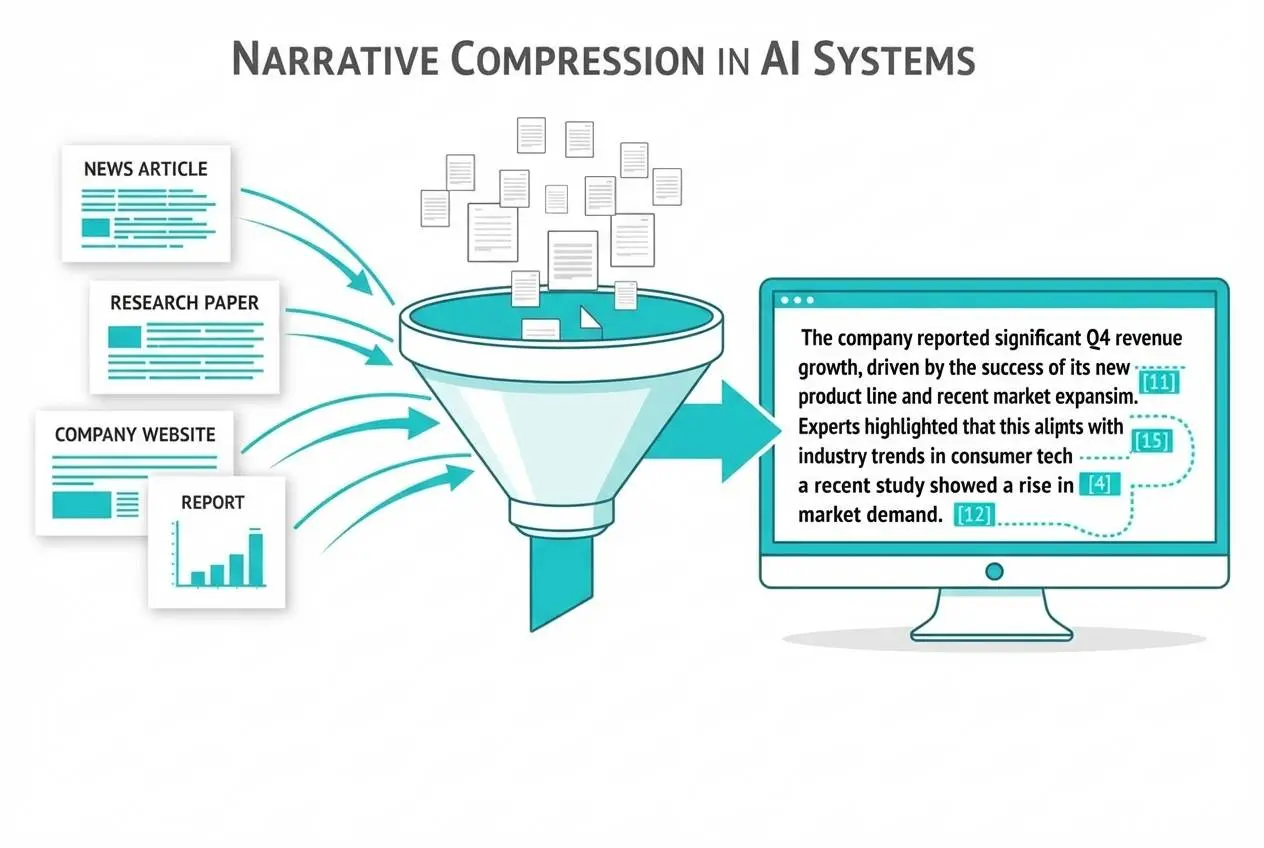
When AI systems synthesize answers, they compress complex information from multiple sources into concise responses. This compression process inevitably loses nuance, omits context, and makes interpretive decisions about what matters most.
Narrative compression affects how organizations are represented:
Full Source Content: A company's website describes fifteen years of healthcare technology experience, specific HIPAA compliance certifications, three distinct product lines, implementation methodology, customer success metrics, and strategic partnerships.
AI Synthesis Output: "Company provides healthcare technology solutions with HIPAA compliance and implementation support."
The compression preserves basic facts but loses strategic differentiators, specific capabilities, quantifiable outcomes, and competitive positioning nuances. Organizations cannot prevent compression, but they can influence what gets preserved through content structure and quotability.
How AI Systems Decide What to Preserve
AI synthesis doesn't randomly compress information. The systems make predictable decisions about what to preserve based on:
Specificity: Concrete details get preserved over vague descriptions. "Reduces implementation time by 40% compared to industry average" survives compression better than "fast implementation."
Quantification: Numbers and metrics get preserved because they provide specific, comparable information. "Serves 200+ hospitals" survives better than "widely used in healthcare."
Definitional Statements: Clear explanations of what something is get preserved. "X is a governance framework for AI adoption in regulated industries" survives better than marketing language.
Comparative Information: Explicit comparisons help AI systems understand positioning. "Unlike strategy-focused consultants, X provides implementation support" survives better than implicit differentiation.
Quotable Phrases: Complete thoughts that work as standalone sentences get extracted. Long paragraphs with embedded key points get compressed, potentially losing those points.
Organizations can influence compression outcomes by structuring content around what AI systems preserve: specific, quantified, definitional, comparative, and quotable statements.
The Citation and Attribution Challenge
AI systems sometimes cite sources explicitly and sometimes synthesize without attribution. When citations appear, they validate source authority and can drive traffic. When synthesis happens without attribution, organizations influence the narrative but receive no direct credit.
The citation decision depends on:
- Query type (factual questions more likely to generate citations than opinion questions)
- Information specificity (unique data points more likely to be cited than common knowledge)
- Source authority (recognized sources more likely to receive attribution)
- Synthesis complexity (single-source answers more likely to cite than multi-source syntheses)
Organizations should optimize for both scenarios: being influential in synthesis and being cited explicitly when possible. This requires content that is both quotable for extraction and authoritative enough to warrant citation.
Strategic Implications for Content Development
The shift from ranking to rewriting requires fundamentally different content development strategies. Organizations must create reference material for AI systems rather than content optimized for search algorithms.
Creating Quotable, Extractable Content
AI systems extract specific statements rather than summarizing entire pages. Content must be structured for extraction:
Quotable Paragraph Structure: Each paragraph should contain complete thoughts that work as standalone statements. Avoid building meaning across multiple paragraphs where extracting one paragraph loses essential context.
Definitional Clarity: Lead with clear definitions. "AI Visibility is the governance of how organizations appear within AI-mediated decision systems" works better than burying definitions in explanatory text.
Specific Claims: Make concrete, specific claims rather than general statements. "81% of technology buyers prioritize ethical AI use in vendor selection" works better than "many buyers care about AI ethics."
Comparative Frameworks: Explicitly state comparisons rather than implying them. "Unlike traditional SEO which optimizes for ranking, GEO optimizes for synthesis accuracy" works better than describing GEO without explicit comparison.
Standalone Sentences: Ensure individual sentences convey complete thoughts. Avoid pronouns without clear antecedents, relative clauses that require previous context, or dependencies on surrounding sentences for meaning.
Optimizing for Authority Signals
AI systems select sources based on perceived authority within specific domains. Organizations must establish signals that AI systems recognize as authoritative:
Domain Expertise Demonstration: Publish content that demonstrates deep domain knowledge rather than broad marketing messages. Detailed technical explanations, research findings, and specialized frameworks signal expertise.
Citation by Other Authorities: Being referenced by recognized authoritative sources signals to AI systems that your content merits inclusion. Strategic partnership content, industry publication features, and academic citations build this signal.
Consistency Across Sources: Information about your organization should be consistent across your website, industry databases, news coverage, and partner content. Inconsistency signals unreliability to AI systems.
Structured Data Implementation: Schema.org markup and other structured data formats help AI systems understand and extract information accurately. Organization schema, product schema, and FAQ schema particularly aid AI comprehension.
Primary Source Material: AI systems favor primary sources over secondary summaries. Publishing original research, proprietary data, and first-hand case studies establishes primary source authority.
Measuring Success in an AI-Synthesis World
Traditional metrics like page rankings, organic traffic, and click-through rates become less relevant when AI systems synthesize answers without generating clicks. Organizations need new metrics that measure influence in synthesis rather than traffic from ranking:
AI Citation Frequency: How often do AI systems cite your organization when answering relevant queries?
Synthesis Accuracy: When AI systems mention your organization, how accurately do they represent your capabilities and positioning?
Source Selection Rate: What percentage of relevant queries result in AI systems selecting your content as source material?
Competitive Positioning: When AI systems compare your organization to competitors, is the positioning accurate and favorable?
Narrative Consistency: Do AI synthesis outputs align with your strategic positioning and messaging?
These metrics require active monitoring through:
- Regular queries to major AI systems on topics where you want visibility
- Comparison of AI-generated descriptions to your intended positioning
- Tracking which of your content gets referenced versus competitors
- Assessment of how AI systems characterize your competitive differentiation
Industry-Specific Implications
Different industries experience the ranking-to-rewriting shift with varying intensity and timing. Understanding industry-specific dynamics helps organizations prioritize their response.
Professional Services
High AI Synthesis Impact: Prospective clients increasingly use AI systems to research service providers, understand capabilities, and compare options before human contact.
Key Challenges: Service differentiation often relies on nuance that gets lost in synthesis. AI systems may compress sophisticated methodologies into generic service categories.
Strategic Response: Create highly quotable content that explicitly states differentiation. Publish specific methodologies, frameworks, and approaches that AI systems can extract intact. Use concrete case study outcomes rather than general capability statements.
Technology and Software
Extremely High AI Synthesis Impact: Technical buyers use AI systems extensively for initial product research, feature comparison, and implementation guidance.
Key Challenges: Technical specifications must be precise for AI extraction. Integration capabilities, performance metrics, and compliance certifications need structured presentation.
Strategic Response: Implement comprehensive structured data markup. Create detailed technical documentation with extractable specifications. Publish benchmark data and comparison frameworks that AI systems can reference.
Healthcare and Life Sciences
Emerging AI Synthesis Impact: Clinical and regulatory constraints limit AI system confidence in healthcare recommendations, but procurement and vendor research show increasing AI mediation.
Key Challenges: Regulatory compliance information must be accurate in synthesis. Clinical evidence and safety data require precise extraction.
Strategic Response: Structure regulatory and compliance information for AI accessibility. Create clear, quotable safety and efficacy statements. Ensure clinical evidence is presented in extractable formats.
Financial Services
Complex AI Synthesis Environment: Regulatory requirements and risk sensitivity create both opportunities and constraints for AI synthesis in financial services.
Key Challenges: Performance data must be accurate and contextualized. Regulatory compliance must be clear. Risk disclosures must survive compression.
Strategic Response: Create structured presentations of performance metrics. Develop quotable compliance statements. Ensure risk information is extractable without losing essential context.
Preparing for Increasing AI Synthesis Sophistication
AI systems continue improving their synthesis capabilities, expanding the scope of queries they can answer directly, and reducing reliance on presenting ranked lists for user evaluation.
Anticipated Developments
Multi-Source Attribution: Future AI systems may provide clearer attribution to multiple sources within synthesized answers, creating both visibility opportunities and quality requirements.
Context-Aware Synthesis: AI systems will better maintain context across related queries within conversations, requiring organizations to ensure comprehensive coverage across related topics.
Synthesis Verification: As AI systems become more sophisticated, they may implement verification processes that check synthesis accuracy against source materials, rewarding precise, quotable content.
Competitive Framework Evolution: AI systems will develop more sophisticated competitive frameworks, making explicit comparative positioning more important.
Domain-Specific Synthesis: Specialized AI systems for specific industries will emerge with different source selection criteria and synthesis approaches, requiring industry-adapted content strategies.
Strategic Positioning for Evolution
Organizations should position themselves for AI synthesis evolution by:
Building Comprehensive Reference Libraries: Create extensive documentation that AI systems can reference across related queries within your domain. Single-page content optimized for one keyword won't serve AI synthesis needs.
Establishing Primary Source Authority: Publish original research, proprietary methodologies, and unique data that positions your organization as a primary source for AI systems to reference.
Maintaining Narrative Consistency: Ensure strategic positioning and key messages remain consistent across all content as AI systems increasingly cross-reference multiple pages and sources.
Developing Structured Content Systems: Implement content management approaches that ensure information structure, quotability, and extractability across all published content.
Monitoring Synthesis Evolution: Track how AI systems improve their synthesis of your industry and organization to adapt content strategies as capabilities evolve.
FAQ
What does it mean that AI rewrites instead of ranks?
AI systems synthesize new text by combining information from multiple sources rather than presenting ranked lists of search results. This means organizations compete to be selected as source material and accurately represented in synthesized answers rather than competing for ranking positions.
How do I optimize content for AI synthesis instead of search ranking?
Focus on creating quotable, specific, definitive statements that AI systems can extract intact. Use structured data markup, provide concrete metrics and comparisons, lead with clear definitions, and ensure individual paragraphs work as standalone thoughts.
Why do zero-click searches matter for my organization?
Zero-click searches mean users get answers directly from AI systems without visiting your website. You can be visible and influential in shaping AI responses while receiving minimal traffic, requiring you to value narrative influence over click-through rates.
How can I measure whether AI systems are using my content?
Query major AI systems with questions relevant to your domain and track: citation frequency, synthesis accuracy, whether your organization appears in competitive comparisons, and how accurately AI systems represent your capabilities.
What is narrative compression and why does it matter?
Narrative compression is how AI systems reduce complex information into concise summaries. This matters because nuance, context, and differentiation often get lost. You can influence what gets preserved by making key points specific, quantified, and quotable.
Should I still care about traditional SEO if AI systems synthesize answers?
Traditional SEO remains relevant because search engines haven't disappeared and some users still click through results. However, you should expand beyond SEO to include GEO (Generative Engine Optimization) focused on AI synthesis.
How do AI systems decide which sources to cite versus synthesize without attribution?
Citation decisions depend on query type, information uniqueness, source authority, and synthesis complexity. Factual queries with specific data points from recognized sources are more likely to generate citations than synthetic answers combining multiple sources.
What makes content authoritative to AI systems?
AI systems recognize authority through: domain expertise demonstration, citation by other authoritative sources, consistency across platforms, structured data implementation, primary source material, and recognition within your industry.
How often should content be updated for AI synthesis?
Content should be updated when information becomes outdated or strategic positioning changes. AI systems favor recent information, but constant updates aren't necessary if core content remains accurate and relevant.
Can small organizations compete with larger companies in AI synthesis?
Yes. AI synthesis favors specific, quotable, authoritative content over size. Smaller organizations with clear expertise and well-structured content can achieve AI visibility in specialized domains even when competing with larger organizations.
What is the difference between SEO and GEO?
SEO (Search Engine Optimization) optimizes for ranking in search results that users click through. GEO (Generative Engine Optimization) optimizes for accurate representation in AI-synthesized answers that users consume directly without clicking.
How do I know if my content is quotable enough for AI systems?
Test whether individual paragraphs convey complete thoughts without requiring surrounding context. Quotable content contains specific claims, clear definitions, concrete comparisons, and standalone sentences that work independently.
References
[1] The Rise Of Ai Search And What It Means For Seo - https://www.searchenginejournal.com/the-rise-of-ai-search-and-what-it-means-for-seo/
[2] How Ai Is Transforming Search And Discovery - https://www.forbes.com/sites/forbestechcouncil/2026/01/15/how-ai-is-transforming-search-and-discovery/
[3] Zero Click Searches The Future Of Seo - https://moz.com/blog/zero-click-searches-future-of-seo
[4] Optimizing For Ai Search Engines - https://www.semrush.com/blog/ai-search-optimization/
[5] The Shift From Search Engines To Answer Engines - https://www.searchenginewatch.com/2026/01/shift-from-search-to-answer-engines/
[6] Generative Engine Optimization Geo Strategies - https://www.siegemedia.com/strategy/generative-engine-optimization
[7] How Ai Synthesizes Information From Multiple Sources - https://www.contentatscale.ai/blog/ai-content-synthesis/
[8] The Death Of Traditional Seo - https://www.searchengineland.com/death-of-traditional-seo-ai-era-394523
[9] Creating Content For Ai Visibility - https://www.hubspot.com/marketing/ai-content-optimization
[10] Measuring Success In The Age Of Ai Search - https://www.conductor.com/blog/measuring-ai-search-success/
About the Author
Sergio D'Alberto is the founder of ABL (AI.BUSINESS.LIFE.), an AI strategy and adoption advisory. His work focuses on helping leadership teams navigate AI governance, visibility strategy, and responsible adoption.
Prior to founding ABL, Sergio spent 16 years at Microsoft, most recently in Azure Engineering.
Related Essays
Why GEO Without SEO Is a House Without a Foundation
GEO (Generative Engine Optimization) is gaining strategic attention, but organizations that pursue it while neglecting SEO fundamentals are building on unstable ground. This essay explains why the two disciplines are interdependent — and what the right sequencing looks like.
Why Press Releases Are Invisible to AI and What Actually Builds Citation Authority
Press releases have almost no impact on AI visibility. This essay explains why the standard PR approach fails in AI-mediated contexts — and what organizations should do instead to build the citation authority that AI systems actually recognize.
Why Reddit Has Become One of the Most Important AI Visibility Assets for Your Business
Reddit is not a social media channel. For AI systems, it is a high-authority source of peer opinion, product context, and industry narrative. This essay explains why Reddit presence now shapes AI-generated business representations.